February 2027 Full Moon Calendar: Your Definitive Guide to the Snow Moon & Subtle Lunar Eclipse
Are you tracking the moon’s mystical dance across the night sky? Perhaps you’re planning an evening of stargazing, or simply seeking to align with the lunar rhythm. Whatever your reason, you’re in the right place to get the definitive lowdown on the February 2027 Full Moon.
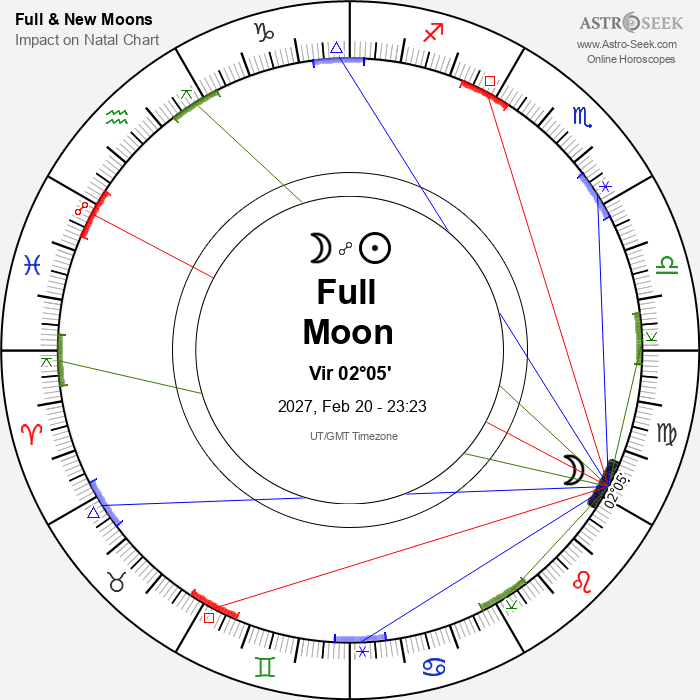
Mark your calendars: The full moon in February 2027, traditionally known as the Snow Moon, will grace our skies on Saturday, February 20, 2027. But here’s a subtle cosmic bonus: it will coincide with a Penumbral Lunar Eclipse. While not as dramatic as a total lunar eclipse, it’s a fascinating celestial alignment that adds an extra layer to this already significant lunar event.

Forget the vague forecasts and scattered details. We’re diving deep into the exact timing, cultural significance, and the best ways to experience this mid-winter celestial show. Get ready to illuminate your understanding of the February 2027 Full Moon!
The February 2027 Full Moon: The Snow Moon Shines with a Lunar Eclipse
Let’s cut right to it. The primary reason you’re here is for the details, and we’ve got them precisely for you.
When Exactly Is the February 2027 Full Moon?
The February 2027 Full Moon will occur on:
- Date: Saturday, February 20, 2027
- Exact Time (UTC): 23:23 UTC
For those of us in the United States, that means the peak illumination will fall on:
| Time Zone | Local Full Moon Time |
|---|---|
| Eastern Standard Time (EST) | 6:23 PM EST (Feb 20) |
| Central Standard Time (CST) | 5:23 PM CST (Feb 20) |
| Mountain Standard Time (MST) | 4:23 PM MST (Feb 20) |
| Pacific Standard Time (PST) | 3:23 PM PST (Feb 20) |
| Alaska Standard Time (AKST) | 2:23 PM AKST (Feb 20) |
| Hawaii Standard Time (HST) | 1:23 PM HST (Feb 20) |
Remember that the moon will appear full for roughly three days surrounding these precise moments, so you’ll have ample opportunity to observe its glorious presence.
A Penumbral Lunar Eclipse: What You Need to Know
Adding a fascinating dimension to the February 2027 Full Moon is a penumbral lunar eclipse. Unlike a total or partial lunar eclipse, where the Moon passes through the darker, central part of Earth’s shadow (the umbra), a penumbral eclipse sees the Moon only grazing the lighter, outer part of Earth’s shadow (the penumbra).
What does this mean for observers in the USA?
- Subtle Effect: Don’t expect a dramatic darkening or reddening of the moon. The change will be quite subtle, almost imperceptible to the casual observer. The moon might appear slightly dimmer or have a faint shading on one side.
- No Special Equipment: You won’t need any special glasses or equipment to view this. It’s safe to look at with the naked eye.
- Visibility: If conditions are clear, those in areas where the full moon is visible (essentially, the entire USA) will be experiencing the eclipse simultaneously with the peak full moon.
While subtle, knowing you’re witnessing the Earth’s shadow gently brushing against our lunar companion adds a layer of cosmic wonder to your moon-gazing experience.
Navigating the Lunar Cycle: February 2027 Moon Phases at a Glance
While the Full Snow Moon is the star of February, the entire lunar cycle offers a beautiful progression. Understanding all the phases can help you plan your observations and appreciate the moon’s journey throughout the month.
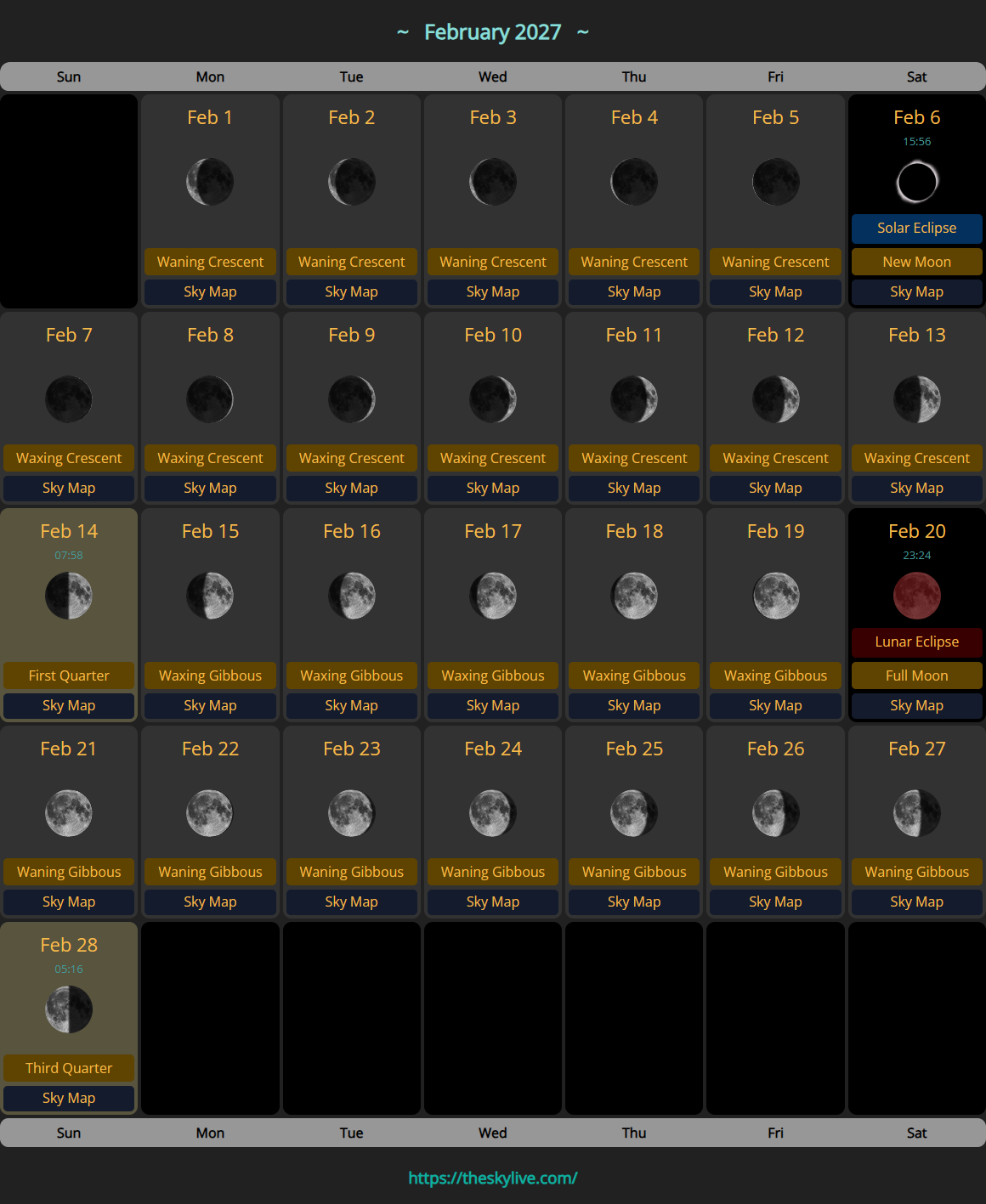
Your Complete February 2027 Moon Phase Calendar
Here’s a detailed breakdown of all the major moon phases for February 2027, with the Full Moon highlighted:
| Date | Phase | Time (UTC) | Illumination (%) |
|---|---|---|---|
| Feb 1, Mon | Waning Crescent | All day | ~20-10% |
| Feb 6, Sat | New Moon | 10:48 UTC | 0% |
| Feb 13, Sat | First Quarter | 08:15 UTC | 50% |
| Feb 20, Sat | FULL MOON (Snow Moon & Penumbral Lunar Eclipse) | 23:23 UTC | 100% |
| Feb 27, Sat | Last Quarter | 20:30 UTC | 50% |
| Feb 28, Sun | Waning Crescent | All day | ~40% |
Beyond the Full Moon: Other Key Phases in February
While the full moon often captures our attention, each phase holds its own beauty and significance:
- New Moon (February 6): This is the invisible moon, when it’s positioned between the Earth and the Sun, presenting its unilluminated side to us. It’s often seen as a time for new beginnings, setting intentions, and quiet contemplation.
- First Quarter (February 13): Half of the moon is illuminated, appearing as a half-circle in the sky. This phase signifies growth, action, and building momentum towards your goals.
- Last Quarter (February 27): Again, half of the moon is lit, but this time it’s the opposite half from the First Quarter. This phase is about releasing, clearing, and letting go of what no longer serves you as you prepare for the next New Moon cycle.
By understanding the entire lunar cycle, you can better appreciate the dynamic celestial mechanics at play throughout February.
The Rich Lore of the Snow Moon
Beyond the scientific data, full moons carry profound cultural and historical weight. The February Full Moon is famously known as the Snow Moon, a name steeped in tradition.
Origins of the “Snow Moon” Name
The names we use for full moons often trace back to Native American tribes, as well as colonial American and European folklore. These names reflected the seasonal changes and natural events occurring at that time of year.
- Native American Roots: February was historically the snowiest month in many regions of North America, making travel and hunting difficult. Tribes would name this moon the Snow Moon or the Hunger Moon, reflecting the harsh conditions and scarcity of food.
- European Connections: Similarly, ancient European cultures also had names tied to winter’s grip, like the
Storm Moon
orIce Moon
.
This enduring name reminds us of the deep connection early humans had with nature and the cyclical rhythms of the cosmos. It’s a testament to winter’s enduring power and beauty.
What Does a Full Moon Symbolize?
Throughout history and across cultures, the full moon has been a potent symbol. It’s a time of:
- Culmination and Completion: The moon is at its peak illumination, representing the culmination of efforts, the completion of projects, and the full realization of intentions set during the New Moon.
- Illumination and Clarity: Just as the full moon lights up the night, it’s often associated with bringing hidden truths to light, offering clarity, and revealing what needs attention.
- Release and Letting Go: Many traditions view the full moon as an opportune time to release old patterns, negativity, or anything that no longer serves one’s highest good.
- Heightened Energy: There’s a widely held belief that full moons bring a surge of energy, intensifying emotions and experiences.
For the Snow Moon specifically, its symbolism often intertwines with themes of endurance, resilience, and survival during challenging times, much like the winter season itself. It can be a moment for introspection on inner strength.
Experiencing the Full Moon: Observation & Reflection
Now that you know when and what the February 2027 Full Moon is all about, let’s talk about how to truly experience it. It’s more than just a date on a calendar; it’s an opportunity for connection and contemplation.
Best Ways to Observe the Snow Moon & Eclipse
Making the most of your full moon observation is simple, yet incredibly rewarding:
- Find a Clear View: Step outside, away from city lights if possible, and find an unobstructed view of the eastern horizon as the moon rises around sunset, or the western horizon as it sets closer to dawn.
- Check the Weather: Cloud cover can obviously obstruct your view. Keep an eye on local forecasts closer to February 20th.
- Time Your Viewing: While the moon appears full for a few days, observing it around the exact peak time (see table above for your local time) or shortly after moonrise can offer the most dramatic views.
- Use Binoculars (Optional but Recommended): Even standard binoculars can reveal incredible detail on the lunar surface – craters, maria (dark plains), and mountain ranges become strikingly clear. For the subtle penumbral eclipse, binoculars might help you discern the faint shading.
- Photography: A smartphone camera can capture decent shots of the full moon, but a DSLR with a telephoto lens will yield stunning detail. Experiment with manual settings (lower ISO, faster shutter speed).
- Warm Up: Remember it’s February! Bundle up in layers, grab a warm drink, and enjoy the crisp winter air as you gaze skyward.
Remember, this penumbral eclipse is subtle, so focus on the sheer beauty of the full moon itself, and consider the eclipse an added, gentle layer to the experience.
Full Moon Practices: Harnessing Lunar Energy
Many individuals use the energy of the full moon for personal reflection and growth. Here are a few simple, human-centric practices you might consider:
- Lunar Journaling: Take some time to write down your thoughts, feelings, and what you’ve accomplished since the last new moon. Reflect on what has come to fruition.
- Release Ritual: Write down anything you wish to release – old habits, fears, negative thought patterns. Once written, you might safely burn the paper (outdoors, in a fire-safe container) or tear it up, symbolizing letting go.
- Meditation or Contemplation: Sit quietly under the moonlight. Focus on gratitude, clarity, and the natural cycles of life. The Snow Moon’s energy can be particularly potent for reflecting on resilience.
- Moon Water: Place a jar of water outside under the moonlight overnight. Some believe this imbues the water with lunar energy, which can then be used for drinking, watering plants, or cleansing.
These practices are personal and can be adapted to fit your own beliefs and comfort levels. The key is mindful engagement with the celestial event.
The Science Behind the Full Moon & Eclipses
While the cultural and spiritual aspects are rich, it’s also incredibly fascinating to understand the astronomical mechanics that give us these stunning celestial displays.
How a Full Moon Forms
A full moon occurs when the Earth is positioned directly between the Sun and the Moon. From our perspective on Earth, the entire face of the Moon is illuminated by the Sun’s light. It’s a beautiful geometric alignment:
Sun → Earth → Moon
Because the Moon’s orbit is slightly tilted relative to Earth’s orbit around the Sun, a full moon doesn’t usually result in a lunar eclipse. Most of the time, the Moon passes slightly above or below Earth’s shadow. Only when the alignment is precise do we get an eclipse.
Understanding Lunar Eclipses: Penumbral Explained
Lunar eclipses happen when the Earth passes directly between the Sun and the Moon, casting a shadow on the lunar surface. Earth actually creates two parts to its shadow:
- The Umbra: This is the dark, central part of Earth’s shadow. If the Moon passes through the umbra, we see a total or partial lunar eclipse, where the Moon can appear reddish due to light scattering in Earth’s atmosphere.
- The Penumbra: This is the lighter, outer part of Earth’s shadow. During a penumbral lunar eclipse, the Moon only passes through this fainter part. The Earth blocks only a portion of the Sun’s light from reaching the Moon, resulting in the subtle dimming effect you might observe with the February 2027 event.
Think of it like this: if you’re in the umbra of a shadow, the light source is completely blocked. If you’re in the penumbra, the light source is only partially blocked. It’s a delicate cosmic ballet orchestrated by gravity and orbital mechanics.
The Moon’s Influence: Tides and Beyond
The Moon’s gravitational pull is the primary driver of Earth’s ocean tides. During a full moon (and new moon), the Sun, Earth, and Moon are aligned, creating a stronger combined gravitational pull. This results in:
- Spring Tides: Higher high tides and lower low tides.
Beyond tides, the moon has been linked to everything from human behavior to plant growth, though many of these connections remain in the realm of folklore and pseudoscience. Scientifically, the moon’s most measurable impact on Earth is undoubtedly its gravitational influence on our oceans.
Organizations like the National Aeronautics and Space Administration (NASA) constantly monitor and study these celestial mechanics, providing invaluable insights into our solar system.
Looking Ahead: Full Moons in 2027
The February Snow Moon is just one highlight in a year filled with lunar spectacles. Keeping an eye on the full moon calendar for the entire year can help you plan future observations and appreciate the seasonal shifts they represent.
What’s Next? March 2027’s Full Moon
Following the Snow Moon, the next full moon will be the Worm Moon in March 2027, marking the beginning of spring. It’s expected to occur on Saturday, March 20, 2027. This moon traditionally signals the thawing of the ground and the reappearance of earthworms.
Notable Lunar Events in 2027
While February’s eclipse is penumbral, 2027 might hold other exciting lunar events. Always check reliable astronomical sources like the Old Farmer’s Almanac or your local astronomical society for updates on meteor showers, additional eclipses, or particularly bright full moons (like Supermoons, though February 2027’s moon is not a Supermoon).
Embrace the Night Sky
The February 2027 Full Snow Moon, accompanied by a subtle penumbral lunar eclipse, offers a perfect opportunity to pause, look up, and connect with the cosmos. Whether you’re a seasoned astronomer, a curious observer, or someone simply looking to appreciate nature’s grandeur, the moon’s consistent presence is a powerful reminder of our place in the universe. So, bundle up, step outside on February 20th, 2027, and let the Snow Moon illuminate your winter night.
Frequently Asked Questions
When is the Full Moon in February 2027?
The Full Moon in February 2027, known as the Snow Moon, will occur on Saturday, February 20, 2027, reaching its peak illumination at 23:23 Coordinated Universal Time (UTC). This translates to 6:23 PM EST, 5:23 PM CST, 4:23 PM MST, and 3:23 PM PST in the United States.
Will there be a lunar eclipse during the February 2027 Full Moon?
Yes, the February 2027 Full Moon will coincide with a penumbral lunar eclipse. This is a subtle type of eclipse where the Moon passes only through the fainter, outer part of Earth’s shadow (the penumbra). The Moon will appear slightly dimmer or faintly shaded, rather than a dramatic darkening or reddening.
What is the traditional name for the February Full Moon?
The traditional name for the February Full Moon is the ‘Snow Moon.’ This name originated from Native American tribes and early European folklore, reflecting the typically heavy snowfalls and challenging hunting conditions often experienced during this month.
How can I best observe the February 2027 Full Moon and the penumbral eclipse?
To best observe the Full Snow Moon and its subtle penumbral eclipse, find a clear viewing spot away from city lights, if possible. Check local weather forecasts for clear skies. Binoculars can enhance the view of the lunar surface and might help discern the faint eclipse shading. Remember to dress warmly as it will be winter!
What are the other major moon phases in February 2027?
Besides the Full Moon on February 20, 2027, the other major moon phases in February 2027 are: New Moon on February 6 (10:48 UTC), First Quarter on February 13 (08:15 UTC), and Last Quarter on February 27 (20:30 UTC).
What does the Snow Moon symbolize?
The Snow Moon often symbolizes themes of perseverance, resilience, and inner strength during challenging times, much like the winter season it represents. It’s a period associated with completion, illumination, and can be used for reflection and releasing what no longer serves you.