The Full Moon of February 2027: Your Definitive Guide to the Snow Moon in PST
Are you looking ahead to February 2027, eager to pinpoint the exact moment the moon will swell to its luminous peak? You’ve come to the right place. For those of us on the West Coast, or anyone interested in Pacific Standard Time (PST), getting the precise details for celestial events can sometimes feel like navigating a cosmic maze of time zone conversions.
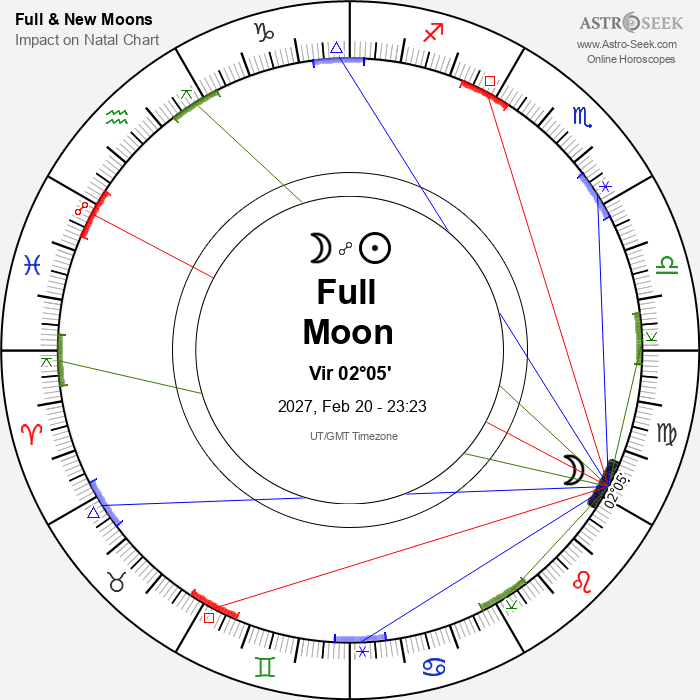
Let’s cut straight to it: The Full Moon of February 2027, traditionally known as the Snow Moon, will grace our skies on Saturday, February 20, 2027, at 3:24 PM PST. Mark your calendars!

But there’s more to this particular full moon than just its date and time. It’s a chance to connect with ancient traditions, marvel at astronomical wonders, and perhaps even witness a subtle celestial dance. Let’s delve into everything you need to know about the February 2027 Full Moon.
When is the February 2027 Full Moon? The Exact Time for Your Location
Knowing the precise moment of the full moon is key for observers, photographers, and anyone planning moonlit activities. While the moon appears full for about three days, its absolute peak illumination occurs at a single, exact moment.
The Snow Moon in Pacific Standard Time (PST)
For those residing in areas observing Pacific Standard Time (UTC-8), the February 2027 Full Moon will reach its zenith at:
- Date: Saturday, February 20, 2027
- Time: 3:24 PM PST (15:24)
This means if you’re in California, Oregon, Washington, Nevada, or British Columbia, you’ll experience the peak illumination in the late afternoon. This timing offers a unique opportunity for viewing, as the moon will be climbing higher in the sky as dusk approaches, providing a dramatic spectacle against the deepening blue.
Global View: Full Moon Times Across Key Time Zones
For our friends around the globe, or if you’re planning an event and need to coordinate, here’s a comprehensive breakdown of the February 2027 Full Moon’s peak illumination across various important time zones:
| Time Zone | Date | Time (24-hour) | Time (12-hour) |
|---|---|---|---|
| UTC (Coordinated Universal Time) | Feb 20, 2027 | 23:24 | 11:24 PM |
| PST (Pacific Standard Time) | Feb 20, 2027 | 15:24 | 3:24 PM |
| MST (Mountain Standard Time) | Feb 20, 2027 | 16:24 | 4:24 PM |
| CST (Central Standard Time) | Feb 20, 2027 | 17:24 | 5:24 PM |
| EST (Eastern Standard Time) | Feb 20, 2027 | 18:24 | 6:24 PM |
| GMT (Greenwich Mean Time) | Feb 20, 2027 | 23:24 | 11:24 PM |
| London, UK (GMT+0) | Feb 20, 2027 | 23:24 | 11:24 PM |
Remember that daylight saving time (DST) is typically not in effect in February, so these standard times should hold true for most regions. Always double-check local observatories or reputable astronomical sites like NASA for the most precise local information.
Unpacking the February 2027 Snow Moon: What Makes It Special?
Beyond its dazzling appearance, the Full Moon of February carries layers of history, folklore, and unique astronomical details. It’s more than just a big, bright circle in the sky.
The “Snow Moon” Name: Origins and Meaning
You’ll often hear the February Full Moon referred to as the Snow Moon. This evocative name isn’t just poetic; it’s deeply rooted in the natural rhythms and historical experiences of various cultures, particularly Native American tribes.
- Native American Folklore: Across numerous indigenous tribes, this moon marked a time of deep winter. February traditionally sees the heaviest snowfall, making hunting difficult and life challenging. Hence, it was aptly named the Snow Moon, reflecting the harsh, snow-laden conditions of the season.
- Other Traditional Names: Given the severe conditions, other names for this moon also highlight hardship. It was sometimes known as the Hunger Moon or Storm Moon, signifying the scarcity of food and the brutal winter storms that defined this period. European traditions also shared similar themes, with names like the “Candlemas Moon” or “Wolf Moon” (though “Wolf Moon” is more commonly associated with January).
These names serve as a powerful reminder of how ancient peoples lived in tune with the lunar cycle and the changing seasons, using the moon as a celestial calendar.
Astronomical Insights: What to Expect in the Sky
The February 2027 Full Moon isn’t just about its name; it offers fascinating astronomical details too:
- Constellation: As the full moon culminates on February 20, 2027, it will be positioned within the constellation of Leo the Lion. This regal constellation is easily recognizable by its bright star Regulus and the ‘Sickle’ asterism. Watching the moon traverse through Leo can be a beautiful sight, especially if you know where to look for the surrounding stars.
- Illumination: At its peak, the moon will be 100% illuminated as observed from Earth, reflecting the maximum amount of sunlight back to us.
- Distance from Earth: The moon’s orbit around Earth isn’t a perfect circle. While not necessarily a “Supermoon” (which occurs when the full moon is near its closest point to Earth, known as perigee), its distance will still be within a range that makes it a prominent object in the night sky. For exact distances, astronomers use complex calculations, but generally, full moons are between 360,000 km and 405,000 km from Earth.
- Moonrise/Moonset: On the evening of February 20th and morning of February 21st, the moon will generally rise around sunset and set around sunrise, appearing in the sky for the entire night. Specific times will vary slightly depending on your exact location along the Pacific Coast.
- Associated Phenomena: A Penumbral Lunar Eclipse! This is a particularly noteworthy detail for the February 2027 Full Moon. A penumbral lunar eclipse is projected to occur on February 20-21, 2027. During a penumbral eclipse, the Moon passes through the Earth’s fainter outer shadow (the penumbra). Unlike a total or partial lunar eclipse, where a distinct shadow darkens a portion of the moon, a penumbral eclipse is often subtle and can be hard to notice for the casual observer. The moon might appear only slightly dimmed or somewhat grayish. However, for keen observers and astrophotographers, it’s a unique event to seek out! This adds an extra layer of intrigue to the Snow Moon experience.
How to Best Experience the February 2027 Full Moon
Whether you’re an avid astronomer, a casual stargazer, or simply someone who appreciates the beauty of the night sky, there are many ways to make the most of the February 2027 Snow Moon.
Tips for Optimal Full Moon Viewing
Experiencing the full moon doesn’t require specialized equipment, but a few tips can enhance your enjoyment:
- Find a Dark Spot: While a full moon is bright enough to cut through some light pollution, seeking out a location away from city lights will offer a clearer, more pristine view. Parks, open fields, or even your backyard (if away from bright streetlights) can be ideal.
- Check the Weather: Clear skies are essential. Cloudy nights, unfortunately, will obscure the view. Keep an eye on the forecast for February 20th and 21st.
- Look for Moonrise/Moonset: For a truly spectacular sight, try to catch the moon as it rises or sets. Near the horizon, the moon can appear larger due to an optical illusion, and its light has to travel through more of Earth’s atmosphere, sometimes giving it a warm, reddish or orange hue.
- Use Binoculars or a Telescope (Optional): While the full moon is stunning to the naked eye, binoculars can reveal fascinating surface details like craters and maria (dark plains). A telescope will offer even closer views, though the full moon’s brightness can sometimes make it challenging to discern subtle features without a moon filter.
Capturing the Snow Moon: Photography Guide
Want to immortalize the Snow Moon? Here are some basic tips for moon photography:
- Equipment: A DSLR or mirrorless camera with a telephoto lens (200mm or more) is ideal. A sturdy tripod is absolutely essential to prevent blur.
- Settings:
- ISO: Keep it low (100-400) to minimize noise.
- Aperture: Start around f/8 to f/11 for good sharpness.
- Shutter Speed: This will vary, but a good starting point for a full moon is often around 1/125 to 1/250 of a second. The moon is surprisingly bright! Experiment.
- Manual Focus: Autofocus can struggle with the moon. Switch to manual focus and use live view to zoom in and achieve critical sharpness.
- Composition: Don’t just point and shoot. Try to include foreground elements like trees, buildings, or silhouettes to add scale and interest to your photos. The penumbral eclipse might be too subtle for most cameras to pick up distinctly without very specific settings and post-processing, but it’s worth a try!
Setting Intentions: Cultural and Spiritual Practices
Many cultures view the full moon as a powerful time for reflection, release, and setting intentions. The Snow Moon, with its themes of resilience and introspection during the depths of winter, can be a potent period for:
- Reflection: Take time to review the past month, acknowledge challenges, and celebrate successes.
- Release: Use the full moon’s energy to let go of old habits, negative thoughts, or anything that no longer serves you.
- Setting Intentions: Look forward to the coming cycle. What do you want to cultivate? What seeds do you want to plant for the spring?
- Quiet Contemplation: Simply sit or walk under the moon’s glow, appreciating its beauty and finding a sense of peace.
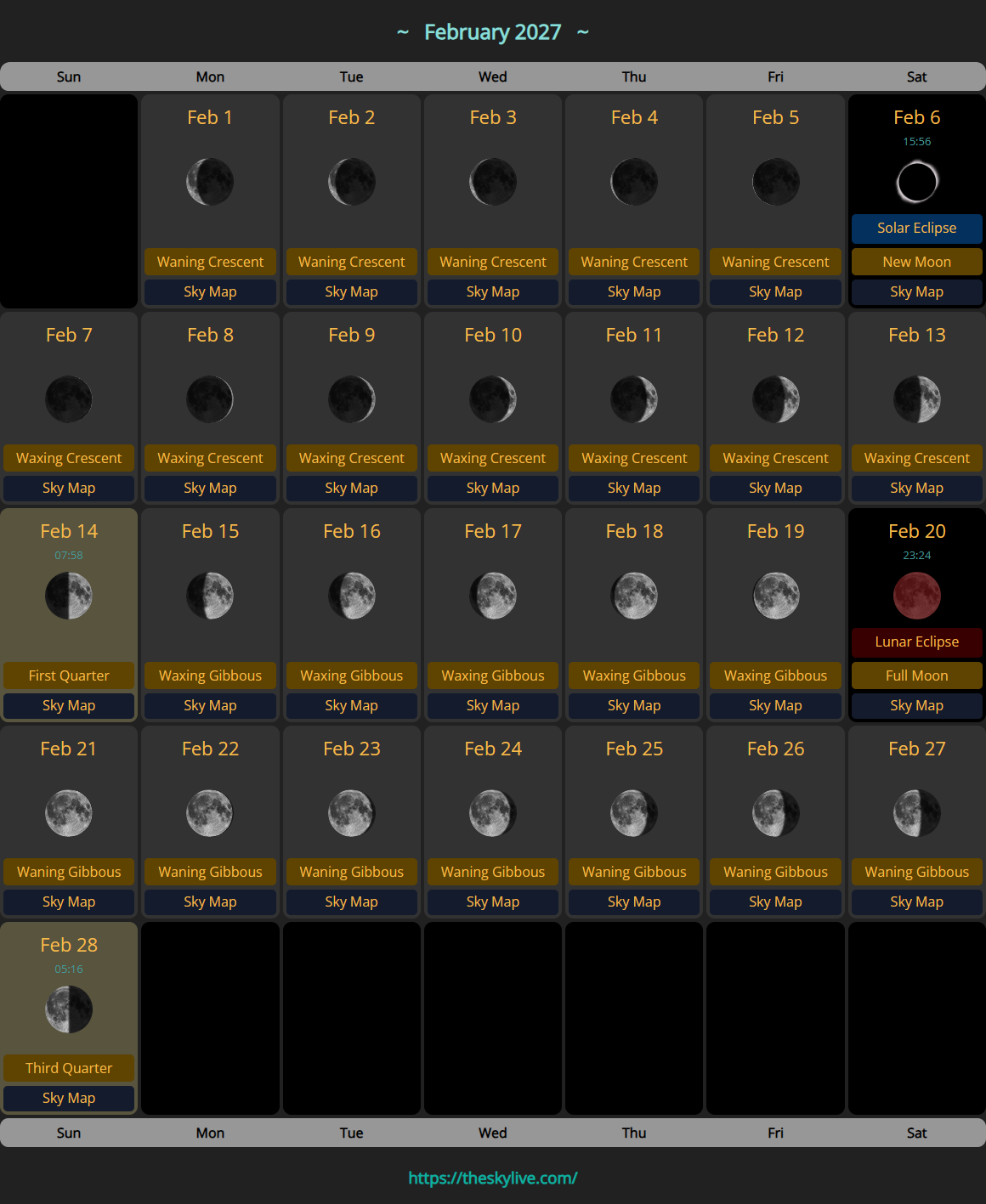
February 2027 Lunar Phases at a Glance
The full moon is just one stop on the moon’s monthly journey. Understanding the entire lunar cycle for February 2027 provides a broader context for the Snow Moon.
| Lunar Phase | Date (2027) | Time (PST) | Time (UTC) |
|---|---|---|---|
| New Moon | February 6 | 7:57 AM | 15:57 |
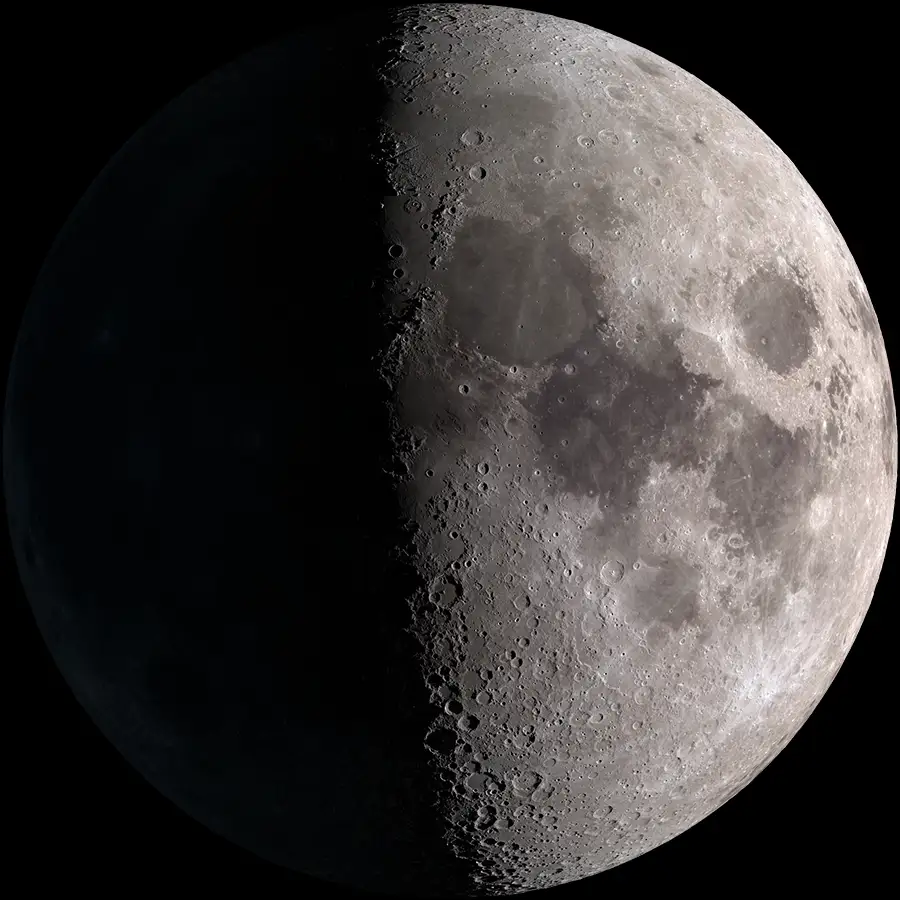
| First Quarter | February 13 | 9:59 PM | 05:59 (Feb 14) |
| Full Moon (Snow Moon) | February 20 | 3:24 PM | 23:24 |
| Last Quarter | February 28 | 7:15 AM | 15:15 |
This table gives you a complete picture of the lunar month, allowing you to track the moon’s journey from invisibility to full glory and back again.
Looking Beyond: Other Significant Lunar Events in 2027
While the February 2027 Snow Moon is certainly a highlight, the year 2027 promises other captivating lunar events. Keeping a broader lunar calendar in mind helps you plan for future celestial observations.
- March 2027 Full Moon (Worm Moon): Following the Snow Moon, March will bring the Worm Moon, signaling the thawing of the ground and the reappearance of earthworms. This usually occurs around March 22, 2027.
- April 2027 Full Moon (Pink Moon): In April, we’ll welcome the Pink Moon, named after the early spring blooming of wild ground phlox. This is typically around April 20, 2027.
- Additional Eclipses: Beyond the subtle penumbral eclipse in February, 2027 may feature other more dramatic lunar or solar eclipses. Consulting an annual astronomical almanac from sources like Time and Date or The Farmers’ Almanac will provide a detailed schedule of these events.
Each full moon throughout the year carries its own unique name and cultural significance, offering a continuous connection to the natural world and the passage of time.
The Science Behind the Phases: Why We See a Full Moon
Understanding the science behind the moon’s phases adds another layer of appreciation to its beauty. The full moon isn’t an arbitrary event; it’s a precise alignment in our solar system.
The moon’s phases are determined by the changing angles at which we view its sunlit surface as it orbits Earth. A full moon occurs when the Earth is positioned directly between the sun and the moon. From our perspective on Earth, the entire face of the moon that is turned towards us is fully illuminated by the sun.
This perfect alignment happens approximately every 29.5 days, which is the length of one synodic month (the time it takes for the moon to complete one cycle of phases). The February 2027 Full Moon on the 20th is the culmination of this cycle, a moment of maximum light and visibility, offering a profound sense of connection to the cosmos.
So, as February 2027 approaches, get ready to gaze up at the magnificent Snow Moon. Whether you’re tracking its precise moment in PST, exploring its traditional meanings, or simply enjoying its radiant glow, it promises to be a memorable celestial event.
Frequently Asked Questions
What is the exact date and time of the Full Moon in February 2027 in PST?
The Full Moon in February 2027 will occur on Saturday, February 20, 2027, at 3:24 PM Pacific Standard Time (PST).
Why is the February Full Moon called the “Snow Moon”?
The February Full Moon is traditionally called the “Snow Moon” by various Native American tribes because February typically brings the heaviest snowfalls of the year, making hunting and daily life challenging. Other historical names include “Hunger Moon” or “Storm Moon” due to the harsh winter conditions.
Will there be any eclipses during the February 2027 Full Moon?
Yes, there will be a subtle penumbral lunar eclipse associated with the February 2027 Full Moon, occurring on February 20-21, 2027. During a penumbral eclipse, the Moon passes through the Earth’s fainter outer shadow, resulting in a slight dimming that can be difficult to notice without careful observation.
What constellation will the February 2027 Full Moon be in?
At the peak of its illumination on February 20, 2027, the Full Moon will be located within the constellation of Leo the Lion.
How can I best observe the Snow Moon?
For optimal viewing, find a location away from city lights, check the weather for clear skies, and consider watching the moonrise or moonset for a dramatic view. Binoculars can enhance the experience by revealing surface details, and a sturdy tripod is essential for moon photography.
What are the other moon phases for February 2027?
In February 2027, the New Moon is on February 6 at 7:57 AM PST, the First Quarter is on February 13 at 9:59 PM PST, the Full Moon (Snow Moon) is on February 20 at 3:24 PM PST, and the Last Quarter is on February 28 at 7:15 AM PST.
Is the February 2027 Full Moon a Supermoon?
While all full moons are captivating, current astronomical data does not indicate that the February 2027 Full Moon will be a ‘Supermoon.’ A Supermoon occurs when a full moon coincides with the Moon being at or near its closest point to Earth (perigee), making it appear slightly larger and brighter than average.