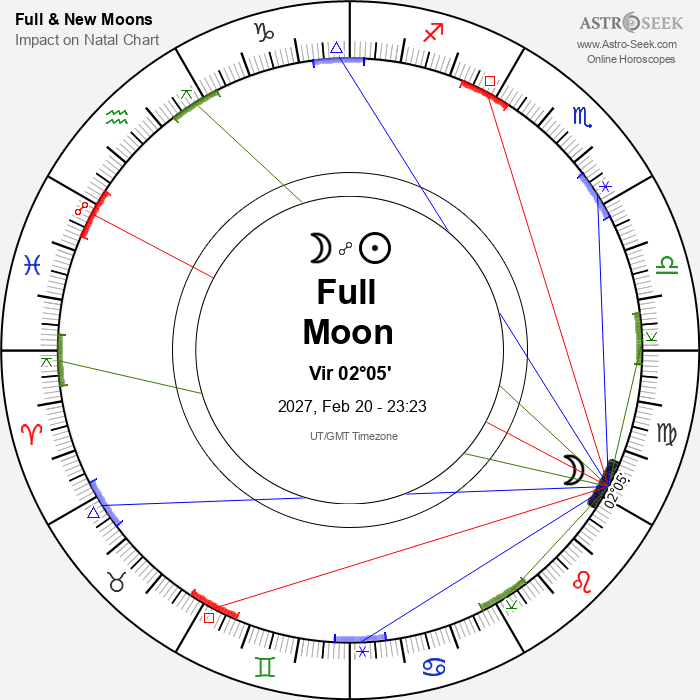
Your Definitive Guide to the Full Moon in February 2027: UK Time and US Insights
Are you a stargazer in the US looking to pinpoint the exact moment of the February 2027 Full Moon in UK time? Perhaps you’re planning a trip, coordinating with friends across the Atlantic, or simply fascinated by celestial events and their global timings. Whatever your reason, you’ve come to the right place. We’re cutting through the clutter to give you the precise details you need, along with cultural context, viewing tips, and crucial time zone conversions.
Forget generic calendars and confusing charts. We’re diving deep into the February 2027 Full Moon, affectionately known as the “Snow Moon,” providing you with not just the exact UK time, but also how that translates to your local time in the United States. Let’s make sure you don’t miss a single magical moment.
The Essential Info: February 2027 Full Moon at a Glance
Here’s the absolute core information you need to know about the February 2027 Full Moon, presented clearly and concisely:
| Event | Date | UK Time (GMT/UTC) | Common US Time (EST) | Traditional Name | Constellation |
|---|---|---|---|---|---|
| Full Moon | Saturday, February 20, 2027 | 23:24 GMT/UTC | 6:24 PM EST | Snow Moon | Leo |
There you have it! The peak illumination of February’s full moon occurs late in the evening in the UK, translating to a convenient evening viewing window across much of the United States. But let’s unpack these details further to ensure you’re fully prepared.
Decoding the February 2027 Full Moon: The “Snow Moon” Unveiled
When is the Full Moon in February 2027? Exact UK Time & Date
For those across the pond or simply tracking international astronomical events, mark your calendars: the Full Moon in February 2027 will reach its maximum illumination on Saturday, February 20, 2027, at precisely 23:24 Greenwich Mean Time (GMT) or Coordinated Universal Time (UTC). These two terms, GMT and UTC, are often used interchangeably, especially for practical purposes, as they represent the same time standard without daylight saving adjustments. For the UK, this means 23:24 on a Saturday night – a prime time for skywatching.
Understanding GMT/UTC is foundational for international timekeeping. It’s the primary time standard by which the world regulates clocks and time. Countries, like the UK, use it as their base time zone (often switching to British Summer Time, or BST, during warmer months, but February 2027 falls firmly within GMT). Knowing this precise reference point makes converting to your local time zone significantly easier, which is exactly what we’ll tackle next.
Why UK Time? Bridging the Atlantic for Stargazers
You might be wondering, “Why specifically UK time if I’m in the US?” It’s a great question, and there are several compelling reasons why a US audience often seeks this particular detail:
- International Coordination: If you have friends, family, or online communities in the UK or other GMT-aligned regions, knowing the precise UK time allows you to share the celestial moment synchronously.
- Source of Truth: Many authoritative astronomical sources, including those that influence global timekeeping, use GMT/UTC as their reference point for celestial events, as established by bodies like the International Astronomical Union (IAU) for clarity. The historic Royal Observatory Greenwich in London, UK, plays a key role in the origins of this global time standard.
- Travel Planning: If you’re planning to be in the UK during February 2027, this information is, of course, directly relevant to your local experience.
- Academic & Research Interest: For astronomers, students, or enthusiasts, understanding the event from a common global standard time is crucial for comparative analysis and data interpretation.
Essentially, UK time acts as a widely recognized benchmark for celestial phenomena, making it a critical piece of information for anyone looking to understand the universal timing of the full moon.
From London to Los Angeles: Converting UK Full Moon Time to Your US Zone
The beauty of a global event like a full moon is that it happens for everyone, everywhere, at the exact same universal moment. What changes is our local clock time. For our US audience, converting 23:24 GMT/UTC on February 20, 2027, is straightforward.
The continental United States observes several primary time zones, each a set number of hours behind GMT/UTC:
- Eastern Standard Time (EST): GMT/UTC – 5 hours
- Central Standard Time (CST): GMT/UTC – 6 hours
- Mountain Standard Time (MST): GMT/UTC – 7 hours
- Pacific Standard Time (PST): GMT/UTC – 8 hours
Remember that February is still winter in the Northern Hemisphere, so Daylight Saving Time will not be in effect in the US or the UK, simplifying our calculations. This means we’ll stick to Standard Time designations for the US zones.
The “Snow Moon” Across US Time Zones: A Quick Conversion Guide
Here’s a handy table to help you convert the February 2027 Full Moon’s UK time to your specific local time zone in the United States. This is a crucial element for planning your viewing, photography, or simply knowing when the moon is at its peak luminescence for your location.
| Location | Time Zone | Time Difference from GMT/UTC | Full Moon Date (Local) | Full Moon Time (Local) |
|---|---|---|---|---|
| London, UK | GMT/UTC | 0 hours | Saturday, February 20, 2027 | 23:24 |
| New York, USA | EST | -5 hours | Saturday, February 20, 2027 | 18:24 (6:24 PM) |
| Chicago, USA | CST | -6 hours | Saturday, February 20, 2027 | 17:24 (5:24 PM) |
| Denver, USA | MST | -7 hours | Saturday, February 20, 2027 | 16:24 (4:24 PM) |
| Los Angeles, USA | PST | -8 hours | Saturday, February 20, 2027 | 15:24 (3:24 PM) |
As you can see, the Full Moon will occur in the late afternoon or early evening across the continental US, making for a potentially stunning sunset or twilight viewing opportunity as the moon rises, already full, in your local sky.
What’s in a Name? The Lore of the “Snow Moon”
Each full moon throughout the year carries traditional names, often originating from Native American tribes, early colonial settlers, and European cultures. These names typically reflect natural phenomena, agricultural cycles, or animal behavior prevalent during that specific month. February’s full moon is famously known as the “Snow Moon.”
Origins of the “Snow Moon”
The name “Snow Moon” is perhaps one of the most fitting and self-explanatory. February historically experiences the heaviest snowfalls in many Northern Hemisphere regions, including both North America and parts of Europe. This deep snow blanket often made hunting difficult and travel treacherous for ancient peoples.
Native American tribes, who relied heavily on observing nature’s rhythms, named this moon for the abundance of snow that covered the land, impacting their ability to forage and hunt. It was a time of scarcity and reliance on stored provisions. The name served as a practical calendar marker, reminding communities of the season’s harsh realities.
Other Names for February’s Full Moon
While “Snow Moon” is the most common, February’s full moon has been known by several other evocative names, each reflecting the challenges or characteristics of the month:
- Hunger Moon: This name, also common among Native American tribes, highlights the difficulties of finding food during the deep winter, as hunting became harder and food stores dwindled.
- Storm Moon: Reflecting the severe winter storms often associated with February.
- Bear Moon: Some tribes noted this as the time when bear cubs were born or when bears began to stir from hibernation.
These names offer a beautiful glimpse into the profound connection early human cultures had with the lunar cycle and the natural world.
Cultural & Astrological Significance
Astrologically, the Full Moon in February 2027 will occur with the Moon in the constellation Leo. This combination brings with it specific energies. Leo is a sign associated with courage, generosity, warmth, and self-expression. A Full Moon typically signifies a culmination, a peak, or a release.
When the Snow Moon is in Leo, it can be a powerful time for:
- Self-Reflection: Reflecting on your personal courage and how you express your authentic self.
- Emotional Release: Letting go of past insecurities or fears that hinder your self-expression.
- Creative Endeavors: Tapping into your inner artist and embracing bold creative projects.
- Social Connection: Expressing warmth and generosity towards loved ones and community.
Culturally, the Snow Moon is a reminder of resilience. It’s a period to honor survival, the enduring spirit, and the quiet strength developed during challenging times, anticipating the eventual return of spring and abundance.
Beyond the Full Moon: February 2027’s Complete Lunar Calendar
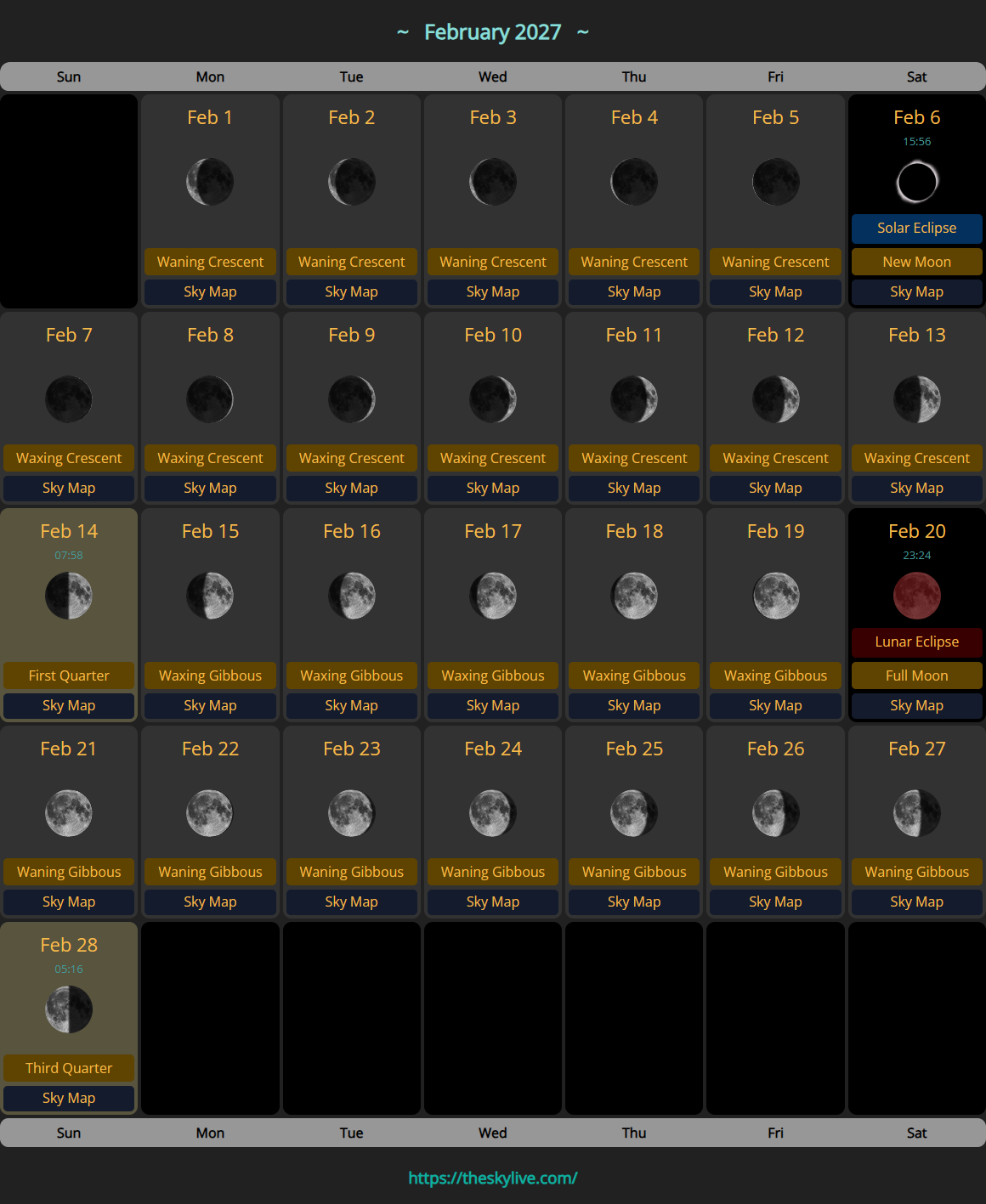
While the full moon garners much of the attention, the lunar cycle is a continuous, fascinating journey through various phases. Understanding the other key phases in February 2027 can enhance your appreciation for our celestial neighbor and your planning for observing its ever-changing face.
Key Lunar Phases for February 2027 (UK Times)
Here’s a snapshot of all the significant lunar phases for February 2027, with their timings presented in UK (GMT/UTC) for consistency:
| Lunar Phase | Date (UK) | Time (UK, GMT/UTC) |
|---|---|---|
| First Quarter Moon | Saturday, February 13, 2027 | 00:09 |
| Full Moon | Saturday, February 20, 2027 | 23:24 |
| Last Quarter Moon | Saturday, February 27, 2027 | 21:18 |
| New Moon (March 2027) | Monday, March 8, 2027 | 01:31 |
This table helps illustrate the progression of the Moon’s illumination throughout the month, from its invisible New Moon phase (which technically falls early March) through its waxing and waning cycles. Observing these different phases can be a rewarding journey for any celestial enthusiast.
Moonrise & Moonset in the UK for the Full Moon Night
While exact moonrise and moonset times vary significantly by your precise location within the UK (or anywhere else), generally, on the night of the Full Moon, the Moon will rise around sunset and set around sunrise. This is because a full moon is directly opposite the Sun in the sky, making it visible for the entire night, from dusk till dawn.
For a precise reading for your specific town or city in the UK, it’s always best to consult local astronomical charts or reputable online resources closer to the date. However, rest assured that on the evening of February 20th and the early morning of February 21st, 2027, the moon will be a prominent feature in the night sky.
Where the Moon Will Be: Constellation & Distance
As mentioned, the Full Moon of February 2027 will occur with the Moon positioned in the constellation Leo. This means if you know how to locate Leo in the night sky, you’ll know where to find the moon!
Regarding its distance, the Moon’s orbit around Earth isn’t a perfect circle; it’s an ellipse. This means there are times when it’s closer to Earth (perigee) and times when it’s farther away (apogee). For the February 2027 Full Moon, the Moon will be approximately 363,306 kilometers (about 225,748 miles) from Earth. This distance falls within a typical range, indicating it will not be an extreme perigee (Supermoon) or apogee event, but a standard, beautiful full moon.
Maximizing Your Full Moon Viewing Experience
Now that you know exactly when the February 2027 Full Moon will occur in both UK and US times, let’s talk about how to make the most of your viewing experience, whether you’re observing from the UK or the United States.
Tips for Observing the February 2027 Full Moon
- Find a Clear View: Seek out a location with an unobstructed view of the eastern horizon (for moonrise) and the entire sky. Hills, tall buildings, or dense trees can block your view.
- Minimize Light Pollution: While a full moon is bright enough to cut through some light pollution, getting away from city lights will significantly enhance your experience, allowing the lunar features to stand out more sharply. Even just turning off your own outdoor lights can make a difference.
- Check the Weather: February can be a cloudy month in many regions. Keep an eye on the forecast for your area. Even if it’s partly cloudy, you might get glimpses!
- Binoculars or a Telescope: While the full moon is stunning to the naked eye, a pair of binoculars or a small telescope will reveal incredible details on the lunar surface, like craters, maria (dark plains), and mountain ranges. The Snow Moon often appears crisper against clear, cold winter air.
- Photography: If you’re into astrophotography, a full moon provides ample light. Use a tripod, adjust your ISO and shutter speed, and experiment with different exposures to capture its brilliance without overexposing.
Can You See the Full Moon Clearly from the US at UK Peak Time?
Yes, absolutely, but with a crucial nuance! The Full Moon reaches its peak illumination at 23:24 GMT/UTC on February 20th. For the US, this translates to late afternoon/early evening on the same day. This means that as the full moon is at its absolute brightest moment in universal time, it will be rising or already visible in the twilight or early night sky for most of the continental US.
You won’t have to wait until deep into the night. In fact, observing the full moon as it rises shortly after sunset can be incredibly beautiful, as atmospheric effects can make it appear larger and give it a golden or orange hue. So, while the UK is heading towards midnight, you’ll likely be enjoying an early evening show in the US!
Planning Ahead: Full Moons Beyond February 2027
The cosmic dance of the Moon is a constant source of wonder. If you’ve enjoyed tracking the February 2027 Full Moon, you’ll likely want to plan for future lunar events. Reputable astronomical organizations and national agencies, like NASA and NOAA, consistently publish accurate moon phase calendars for years in advance.
These resources, readily available online, can help you track future full moons, new moons, eclipses, and even meteor showers. Keeping a dedicated celestial calendar allows you to anticipate these beautiful occurrences and integrate them into your personal planning, whether for observation, photography, or simply appreciating the sky above.
The Full Moon in February 2027, the “Snow Moon” in Leo, promises to be a captivating event for skywatchers everywhere. By understanding its precise timing in UK time and converting it to your local US zone, you’re perfectly positioned to enjoy this celestial spectacle.
Happy stargazing!
Frequently Asked Questions
What is the exact date and time of the February 2027 Full Moon in the UK?
The Full Moon in February 2027 will occur on Saturday, February 20, 2027, at 23:24 Greenwich Mean Time (GMT) or Coordinated Universal Time (UTC).
What is the traditional name for the February Full Moon?
The traditional name for the February Full Moon is the “Snow Moon,” reflecting the heavy snowfalls typically observed during this month in the Northern Hemisphere. It’s also sometimes called the “Hunger Moon” or “Storm Moon.
How can I convert the UK Full Moon time to my local US time zone?
To convert the UK time (23:24 GMT/UTC) to your US time zone, subtract the time difference: EST (-5 hours) makes it 6:24 PM, CST (-6 hours) makes it 5:24 PM, MST (-7 hours) makes it 4:24 PM, and PST (-8 hours) makes it 3:24 PM, all on Saturday, February 20, 2027.
Will the Full Moon in February 2027 be a Supermoon?
No, the February 2027 Full Moon will not be a Supermoon. While it will be approximately 363,306 kilometers from Earth, this distance falls within a typical range and does not qualify it as a Supermoon, which requires the moon to be significantly closer to Earth at perigee.
What constellation will the Moon be in during the February 2027 Full Moon?
During the Full Moon in February 2027, the Moon will be positioned in the constellation Leo.
Why is the UK time relevant if I’m in the USA?
UK time (GMT/UTC) is often used as a global standard for astronomical events. Knowing this precise timing allows for international coordination with friends or communities, provides a consistent reference point for academic interest, and can be useful for travel planning or understanding the universal timing of the event.
What other lunar phases occur in February 2027?
Beyond the Full Moon on February 20th (23:24 GMT/UTC), February 2027 will also feature a First Quarter Moon on February 13th (00:09 GMT/UTC) and a Last Quarter Moon on February 27th (21:18 GMT/UTC).