Your Definitive Guide to February 2026 Holidays in India: What US Travelers & Businesses Need to Know
Planning a trip or business venture in India for February 2026? Don’t get caught off guard! India’s vibrant calendar is dotted with holidays, each carrying deep cultural and regional significance. For US travelers, understanding these dates isn’t just about avoiding closures; it’s about unlocking unique cultural experiences and navigating logistics seamlessly. For businesses, it means smart operational planning.
Table of Contents
- Your Definitive Guide to February 2026 Holidays in India: What US Travelers & Businesses Need to Know
- February 2026 India Holiday Snapshot: At a Glance
- Understanding India’s Holiday System: Gazetted vs. Restricted
- Gazetted Holidays: The National Big Ones
- Restricted Holidays: More Personal & Regional
- State-Specific Holidays: The Local Flavor
- Deep Dive: Key February 2026 Holidays and Their Significance
- Guru Ravidas Jayanti (February 1, 2026)
- Maharishi Dayanand Saraswati Jayanti (February 12, 2026)
- Maha Shivaratri (February 15, 2026)
- Chhatrapati Shivaji Maharaj Jayanti (February 19, 2026)
- Practical Considerations for Your February 2026 India Plans (For US Audience)
- Travel & Tourism Impacts
- Business Operations & Logistics
- Beyond February: Planning Your India Calendar for 2026
- Don’t Just Observe, Experience!
February in India is a fascinating time, often marking the transition from cooler winter days to warmer spring-like weather, making it a popular travel season. However, it’s also a month that hosts several important festivals and observances, which can range from national public holidays affecting banks and government offices to regional celebrations that offer a window into India’s diverse cultural fabric.
This guide cuts through the confusion, providing you with a clear, human-centric breakdown of every significant holiday in February 2026. We’ll tell you what they are, why they matter, and crucially, how they might impact your travel plans or business operations. Get ready to plan smarter, travel richer, and understand India better.
February 2026 India Holiday Snapshot: At a Glance
Let’s kick things off with a quick look at the major holidays you’ll encounter in India during February 2026. This table provides a concise overview, highlighting the date, day, type of holiday, and its primary significance. Remember, some holidays are celebrated nationwide, while others are specific to certain states or communities.
| Date | Day | Holiday Name | Holiday Type | Key States/Significance |
|---|---|---|---|---|
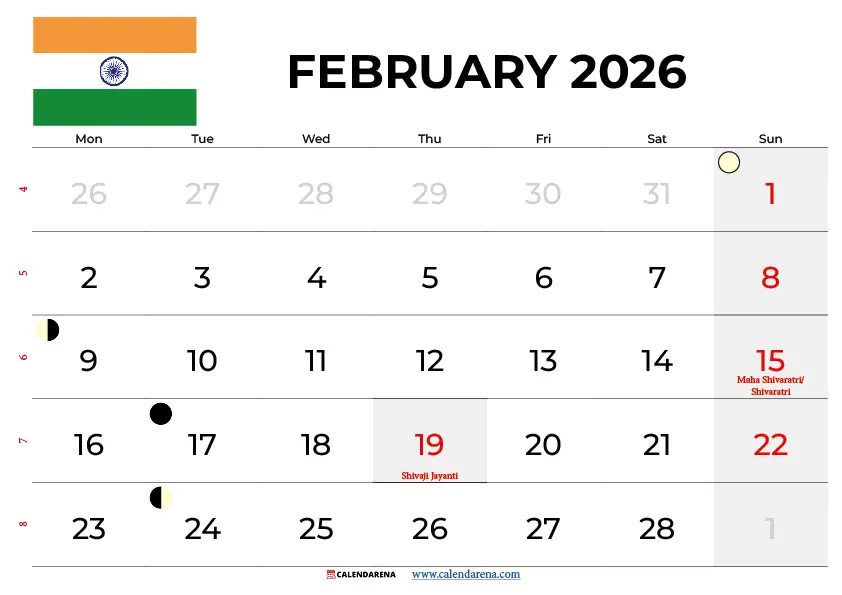
| February 1, 2026 | Sunday | Guru Ravidas Jayanti | State/Regional Holiday | Observed in Punjab, Himachal Pradesh, Haryana, Madhya Pradesh, Chandigarh. Celebrates the birth of Guru Ravidas, a revered Indian mystic. |
| February 12, 2026 | Thursday | Maharishi Dayanand Saraswati Jayanti | Restricted Holiday | Optional holiday for many, celebrating the birth of the Arya Samaj founder. Business operations generally unaffected. |
| February 15, 2026 | Sunday | Maha Shivaratri | Gazetted/Public Holiday | Major Hindu festival dedicated to Lord Shiva. Widely observed across India; banks and government offices may be closed in many states. Significant travel impact. |
| February 19, 2026 | Thursday | Chhatrapati Shivaji Maharaj Jayanti | State Holiday | Primarily observed in Maharashtra, celebrating the birth of the Maratha warrior king. State government offices and some businesses may be closed. |
Understanding India’s Holiday System: Gazetted vs. Restricted
India’s holiday landscape can be a bit tricky to navigate, especially for someone unfamiliar with its nuances. It’s not just about national holidays; there are several categories that dictate how widely a day is observed and what impact it has. Knowing the difference is key to effective planning.

Gazetted Holidays: The National Big Ones
These are the mandatory public holidays declared by the Central Government. Think of them as India’s equivalent to federal holidays in the US. On these days, almost all government offices, banks, post offices, and many businesses across the country are closed. They are universally observed, ensuring a widespread halt to regular operations. For US travelers and businesses, these are the days you absolutely need to factor into your plans, as they can cause significant disruptions to services, travel, and appointments. Maha Shivaratri, while often considered a state-specific public holiday, is widely treated as a major public holiday across many states, leading to similar closures.
Restricted Holidays: More Personal & Regional
Often referred to as Optional Holidays, these are days of cultural or religious significance that are not universally observed. Instead, employees are typically allowed to choose a limited number of these holidays to take off during the year, often two or three. Maharishi Dayanand Saraswati Jayanti is a prime example of a Restricted Holiday. For businesses, this means operations generally continue as usual, though some employees might be absent. For travelers, you’re unlikely to encounter widespread closures, but you might notice some local celebrations or a slightly reduced workforce in certain areas or specific communities.
State-Specific Holidays: The Local Flavor
Beyond the national and restricted categories, each of India’s 28 states and 8 union territories has its own list of holidays. These days commemorate local festivals, historical figures, or regional events. Guru Ravidas Jayanti and Chhatrapati Shivaji Maharaj Jayanti are excellent examples of state-specific holidays observed with great fervor in particular regions. If you’re traveling or conducting business in a specific state, it’s crucial to check that state’s holiday calendar. A holiday in Maharashtra might mean business as usual in Delhi, and vice-versa. These regional variations add to India’s incredible diversity but demand careful planning.
Deep Dive: Key February 2026 Holidays and Their Significance
Now, let’s explore the individual holidays in February 2026 in more detail, understanding their cultural roots and how they are celebrated across India. This context is invaluable for anyone looking to truly appreciate the country’s heritage.
Guru Ravidas Jayanti (February 1, 2026)
Celebrated on the full moon day of the Magh month in the Hindu calendar (Magh Purnima), Guru Ravidas Jayanti honors the birth anniversary of Sant Guru Ravidas, a revered Indian mystic and social reformer. Born in the 15th century in Varanasi, Uttar Pradesh, Guru Ravidas was a prominent figure of the Bhakti movement, known for his spiritual teachings and his relentless advocacy for equality and social justice.
Who was Guru Ravidas? Guru Ravidas was a poet-saint, philosopher, and social reformer whose devotional songs and verses greatly influenced the Bhakti movement. He challenged the rigid caste system prevalent in his time, preaching a message of universal brotherhood, spiritual unity, and the importance of inner purity over external rituals. His teachings emphasize that a person is not great by birth but by deeds.
How is it celebrated? Guru Ravidas Jayanti is primarily observed in states like Punjab, Himachal Pradesh, Haryana, and Madhya Pradesh. Devotees visit temples and gurdwaras (Sikh places of worship, as his teachings are also incorporated into the Guru Granth Sahib), offer prayers, and participate in processions (nagar kirtans). Special programs are organized to recite his teachings and hymns. Feasts (langar) are common, emphasizing community and selfless service. For travelers, if you happen to be in these regions, particularly Punjab, you might witness vibrant local celebrations, hear devotional music, and experience the warmth of community gatherings. While it’s a state holiday in these regions, its impact on general business for non-locals is usually minimal, though local businesses might observe closures.
Maharishi Dayanand Saraswati Jayanti (February 12, 2026)
This day marks the birth anniversary of Maharishi Dayanand Saraswati, a profound philosopher, social reformer, and the founder of the Arya Samaj. Born in 1824 in Tankara, Gujarat, his contributions to reforming Hindu society and his emphasis on returning to the Vedas were revolutionary in 19th-century India.
Who was he? Maharishi Dayanand Saraswati championed the slogan “Go back to the Vedas,” advocating for a reformed Hinduism based on the original teachings of the Vedas, free from idol worship, caste distinctions, and ritualistic complexities that he believed had corrupted the faith. He worked tirelessly for women’s rights, promoting education for girls and condemning child marriage and Sati (widow immolation). His intellectual prowess and reformist zeal made him a towering figure in India’s social and religious landscape.
His teachings and impact: The Arya Samaj, which he founded in 1875, played a crucial role in the socio-religious awakening in India. It promoted education, social service, and a rational approach to religion. His teachings resonated with many who sought a simpler, more egalitarian form of Hinduism. Today, Arya Samaj schools and institutions continue his legacy of education and social reform.
How it’s observed: As a Restricted Holiday, Maharishi Dayanand Saraswati Jayanti is observed mainly by members of the Arya Samaj and their institutions. Special prayers (havans), lectures on his teachings, and community gatherings are common. It’s not a day that typically impacts public services or widespread business operations. For a US traveler, you would likely only notice this holiday if you were specifically visiting an Arya Samaj institution or had direct interactions with members of that community.
Maha Shivaratri (February 15, 2026)
Often referred to as “The Great Night of Shiva,” Maha Shivaratri is one of the most significant and widely celebrated Hindu festivals in India. It falls on the 14th night of the dark half of the Hindu month of Phalguna (or Magha in some calendars). For 2026, it lands on a Sunday, making its observance even more accessible across the country.

Significance: Maha Shivaratri is dedicated to Lord Shiva, one of the principal deities of Hinduism. The festival has multiple layers of significance: it’s believed to be the night Shiva performs the cosmic dance (Tandava), the night he married Goddess Parvati, and the night he saved the world by consuming a deadly poison. Devotees believe that observing the fast and performing rituals on this night helps them overcome darkness and ignorance, and attain spiritual liberation.
Rituals and Celebrations: The celebrations are marked by intense devotion. Many observe a strict fast, often abstaining from food and water for the entire day. Temples dedicated to Shiva come alive with devotees performing Abhishekam (ritual bathing of the Shiva Lingam with milk, water, honey, etc.), offering Bael leaves (Bilva Patra), flowers, and fruits. All-night vigils (jagarans) are common, with devotees chanting mantras, singing devotional songs, and meditating. Major celebrations take place in ancient Shiva temples across India, particularly in places like Varanasi, Ujjain, Somnath, and Rishikesh. The atmosphere is electric with spiritual energy.
Impact on travel/business: As a Gazetted/Public Holiday in many states, Maha Shivaratri will see widespread closures of banks, government offices, and many private businesses. Even where not a declared public holiday, a significant portion of the Hindu population will observe it, leading to reduced staffing or slower service. Roads leading to major Shiva temples can become crowded, and public transport might be busier. For US travelers, this is a prime opportunity to witness a profound spiritual festival, but be prepared for service interruptions. For businesses, expect minimal to no banking services, potential delays in logistics, and reduced operational capacity.
Chhatrapati Shivaji Maharaj Jayanti (February 19, 2026)
Celebrated with immense pride and fervor primarily in the state of Maharashtra, this holiday commemorates the birth anniversary of Chhatrapati Shivaji Maharaj, one of India’s greatest warrior kings and the founder of the Maratha Empire.
Who was Shivaji? Born in 1630 (though historical dates vary slightly, the official date used for the Jayanti is often the Gregorian calendar equivalent of his birth according to the Hindu calendar), Shivaji Raje Bhosale rose from humble beginnings to establish a vast and powerful kingdom against the Mughal Empire. He is revered for his military prowess, administrative skills, and progressive policies, which included religious tolerance and justice for all subjects. He is a symbol of Maratha pride and Indian nationalism.
Significance in Maharashtra: For the people of Maharashtra, Shivaji Maharaj is more than just a historical figure; he is an icon of courage, leadership, and self-rule. His strategies of guerrilla warfare, strong naval force, and emphasis on local governance were far ahead of his time. The celebration of his birthday is a powerful expression of Marathi identity and heritage.
Celebrations: Shivaji Jayanti is a grand affair in Maharashtra. The day is marked by colorful processions (shivajayanti miravanuk), cultural programs, rallies, and speeches glorifying his life and achievements. Forts associated with Shivaji, like Raigad and Shivneri, become focal points of celebration. Young people often dress up as Shivaji or his soldiers, re-enacting historical events. It’s a day of state-wide revelry and remembrance.
Regional Impact: As a State Holiday in Maharashtra, government offices, educational institutions, and many private businesses in Maharashtra will be closed. Public transport might see increased usage due to celebratory events. If your travel or business plans involve Maharashtra, particularly Mumbai, Pune, or other major cities, be prepared for closures and potential crowds related to the festivities. Outside of Maharashtra, this holiday typically has no impact.
Practical Considerations for Your February 2026 India Plans (For US Audience)
Knowing the holidays is one thing; understanding their practical implications for your specific needs as a US traveler or business is another. Let’s break down what you need to consider.
Travel & Tourism Impacts
- Crowds and Domestic Travel: Holidays like Maha Shivaratri (and the surrounding weekend, as it falls on a Sunday) often lead to increased domestic travel. Indians take advantage of long weekends to visit family, go on pilgrimages, or take short trips. This means popular tourist destinations, religious sites, and transportation hubs (train stations, airports) can be significantly more crowded.
- Bookings and Availability: Flights, trains, buses, and hotel accommodations, especially in and around major pilgrimage sites or popular tourist spots, can get booked up quickly and often at higher prices during holiday periods. If your trip coincides with Maha Shivaratri, ensure all your bookings are made well in advance.
- Closures and Limited Services: While tourist attractions like monuments and museums generally remain open, government offices (e.g., visa services, permit offices) and banks will be closed on Gazetted holidays. Smaller shops and services in specific areas, especially near temples during Maha Shivaratri, might also be closed or have reduced hours. Always check ahead for specific venues.
- Cultural Immersion Opportunities: On the flip side, holidays offer an unparalleled opportunity for cultural immersion. Witnessing the fervor of Maha Shivaratri or the parades of Shivaji Jayanti can be a highlight of your trip, providing deep insights into India’s spiritual and historical heritage. Just be mindful of the practicalities.
- Transport Delays: Expect potential delays in road travel around major cities or pilgrimage routes due to increased traffic or processions during festivals.
Business Operations & Logistics
- Banking & Financial Services: This is perhaps the most significant impact for businesses. On Gazetted holidays like Maha Shivaratri (in many states), banks are closed nationwide or within the observing states. This means no transactions, wire transfers, or other banking activities. Plan your financial operations to avoid these dates. Restricted holidays, however, generally do not affect banking.
- Government Offices: All central and state government offices will be closed on Gazetted holidays, and state-specific government offices will be closed on their respective state holidays. This impacts any dealings with bureaucracy, permits, or official documentation.
- Supply Chain & Deliveries: Logistics and supply chains can experience slowdowns or complete halts on public holidays. Transporters might not operate, or their staff might be reduced. If you have critical shipments or deadlines, factor in potential delays, especially around Maha Shivaratri and state holidays in affected regions.
- Client & Partner Availability: If your Indian partners or clients are based in states observing a holiday, expect them to be out of office. Schedule meetings and communications accordingly. Even on Restricted Holidays, some key personnel might choose to take the day off.
- Manufacturing & Production: Factories and production units may operate with reduced staff or close entirely on public holidays, impacting manufacturing schedules.
- Contractual Obligations: Ensure your contracts and agreements with Indian entities account for Indian public holidays, as these might affect delivery dates or service level agreements.
Beyond February: Planning Your India Calendar for 2026
While February offers a taste of India’s diverse holiday calendar, it’s just the beginning. India’s year is replete with festivals, celebrations, and observances from every faith and region. If your plans extend beyond February, consulting a comprehensive calendar for the entire year will save you headaches and enrich your experience.
Whether it’s the vibrant colors of Holi in March, the joyous festivities of Diwali in the fall, or numerous regional harvest festivals, each holiday provides a unique opportunity to understand India’s soul. Embrace the planning process, and you’ll find that navigating India’s holidays becomes part of the adventure.
Don’t Just Observe, Experience!
In conclusion, February 2026 in India presents a blend of significant cultural holidays. Far from being mere obstacles, these days offer windows into the heart of Indian culture. By understanding the distinctions between Gazetted, Restricted, and State holidays, and by appreciating the cultural significance of events like Maha Shivaratri or Shivaji Jayanti, you empower yourself to plan effectively and engage more deeply.
So, whether you’re finalizing a business deal or backpacking through ancient temples, arm yourself with this knowledge. You won’t just be a visitor or an observer; you’ll be part of the vibrant rhythm that is India.
Frequently Asked Questions
What is the most significant holiday in February 2026 for India?
For February 2026, the most significant holiday is Maha Shivaratri on February 15th (Sunday). It is a major Hindu festival observed widely across India, often resulting in closures of banks and government offices in many states. Its observance can significantly impact travel and business operations due to widespread participation.
Are banks and government offices closed on all holidays in February 2026 in India?
No. Banks and government offices are typically closed only on Gazetted Holidays. Maha Shivaratri (Feb 15th) is a key Gazetted Holiday in many states. Restricted Holidays (like Maharishi Dayanand Saraswati Jayanti on Feb 12th) and most State Holidays (like Guru Ravidas Jayanti on Feb 1st and Shivaji Jayanti on Feb 19th outside their respective states) generally do not affect national banking or government services.
How do Restricted Holidays affect US travelers or businesses?
Restricted Holidays have minimal impact on general travel or business operations. While individuals may choose to take these days off, most businesses, government offices, and tourist attractions will remain open. You’re unlikely to encounter widespread closures or service disruptions on a Restricted Holiday like Maharishi Dayanand Saraswati Jayanti.
What’s the best way for a US traveler to plan around Indian holidays?
The best approach is to check a detailed calendar for your specific travel dates and regions. For February 2026, be especially mindful of Maha Shivaratri (Feb 15th). Book accommodations and transportation well in advance, especially if traveling to popular or pilgrimage destinations. Be prepared for potential crowds and some service interruptions. Embracing the cultural aspect of holidays can also enrich your experience!
Will transportation be affected during February 2026 holidays?
During major holidays like Maha Shivaratri, transportation can be affected due to increased domestic travel. Expect trains, buses, and flights to be busier and potentially fully booked. Road travel around major cities or temple towns might also experience delays due to increased traffic or local processions. It’s advisable to factor in extra travel time and book tickets well in advance.
What is the difference between a ‘Gazetted’ and a ‘State’ holiday?
A Gazetted Holiday is declared by the Central Government and is typically observed nationwide, leading to closures of central government offices and banks across India. A State Holiday, on the other hand, is declared by individual state governments and is observed only within that specific state or union territory. For example, Chhatrapati Shivaji Maharaj Jayanti (Feb 19th) is a State Holiday primarily observed in Maharashtra and will only impact operations within that state.