Your Essential Guide to the Gujarati Calendar for February 2026: Vikram Samvat 2082 (Maha-Fagan Month)
Are you looking to connect with your roots, plan family events, or simply stay aligned with vital Gujarati traditions even while living in the USA? The Gujarati calendar isn’t just a list of dates; it’s a living guide to our culture, festivals, and auspicious timings. For February 2026, we’re diving deep into the Vikram Samvat 2082 months of Maha and Fagan to ensure you don’t miss a beat.
Table of Contents
- Your Essential Guide to the Gujarati Calendar for February 2026: Vikram Samvat 2082 (Maha-Fagan Month)
- February 2026 at a Glance: Gujarati Months and Key Transitions
- The Complete Gujarati Calendar for February 2026
- Key Festivals and Important Days in February 2026
- Mahashivratri: The Grand Night of Shiva (February 14-15, 2026)
- Maha Sud Punam: A Full Moon of Blessings (February 1, 2026)
- Vijaya Ekadashi (February 12, 2026)
- Fagan Amas: The New Moon (February 16, 2026)
- Amalaki Ekadashi (February 27, 2026)
- Pradosh Vrat (February 14 & 28, 2026)
- Holika Ashtak Begins (February 24, 2026)
- Understanding Gujarati Panchang Elements for February 2026
- Tithi (Lunar Day): The Rhythm of Time
- Nakshatra (Lunar Mansion): Cosmic Influences
- Yoga & Karan: Deeper Astrological Insights
- Daily Auspicious Timings: Choghadiya for February 2026 (USA Focus)
- Why a Gujarati Calendar Matters, Especially for Gujaratis in the USA
- Navigating the Gujarati Calendar in the Modern World
Many online calendars offer a basic overview, but often lack the depth, cultural context, and practical insights crucial for someone navigating their heritage in a modern, global setting. This guide cuts through the clutter, providing you with a definitive, detailed, and culturally rich resource for February 2026. We’re not just giving you dates; we’re giving you the ‘why’ and the ‘how’, making sure your connection to Gujarati culture remains strong, no matter where you are.
February 2026 at a Glance: Gujarati Months and Key Transitions
February 2026 is a fascinating bridge month in the Gujarati calendar, encompassing the tail end of Maha Mahina (માહ મહિનો) and the beginning of Fagan Mahina (ફાગણ મહિનો), both within the auspicious Vikram Samvat 2082. The Vikram Samvat calendar is a lunisolar calendar, meaning it tracks both the moon’s phases and the sun’s annual cycle, which is why its months don’t perfectly align with the Gregorian calendar.
In February 2026, we start in the second half (Vad Paksha) of Maha month and transition into Fagan month. This period is rich with spiritual significance, leading up to one of the most important festivals in Hinduism, Mahashivratri. Understanding this transition is key to appreciating the flow of festivals and observances.
The Complete Gujarati Calendar for February 2026
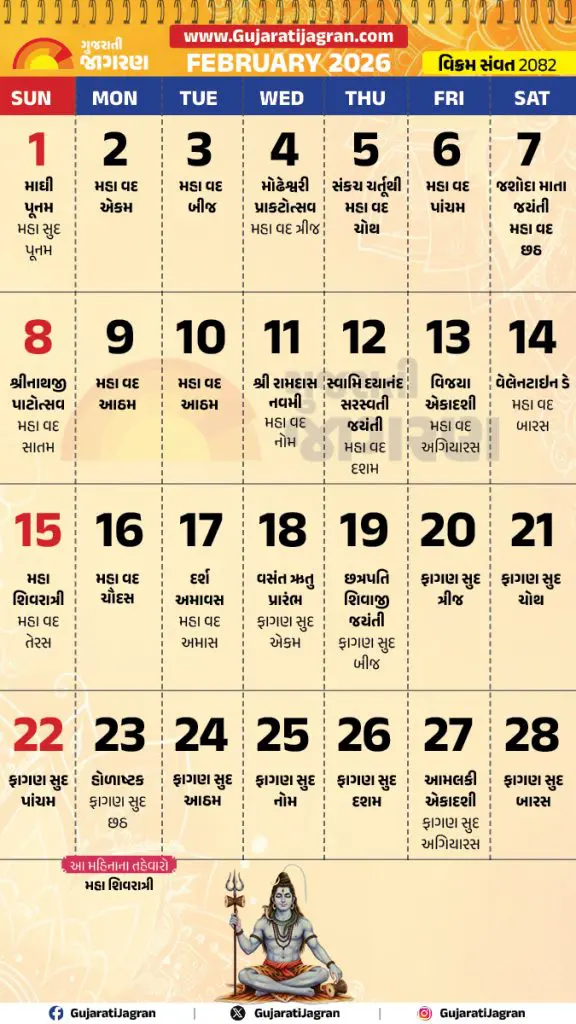
Here’s a detailed, day-by-day breakdown of the Gujarati calendar for February 2026. This isn’t just about festivals; it includes crucial Panchang elements like Tithi, Paksha, Nakshatra, Yoga, and Karan, helping you gain a fuller understanding of each day’s unique astrological blueprint. We’ve simplified it so you can quickly identify important days for spiritual observances, fasting, or planning auspicious events.

| Gregorian Date | Gujarati Tithi | Paksha | Nakshatra | Yoga | Karan | Important Events / Festivals |
|---|---|---|---|---|---|---|
| February 1, Sunday | Maha Sud Punam (15) | Sud (Shukla) | Ashlesha | Shukla | Bhadra | Maha Sud Punam, Guru Ravidas Jayanti, Satyanarayan Puja |
| February 2, Monday | Fagan Vad Padvo (1) | Vad (Krishna) | Magha | Brahma | Kaulav | Fagan Mahina Begins |
| February 3, Tuesday | Fagan Vad Bij (2) | Vad (Krishna) | Purva Phalguni | Indra | Tetil | |
| February 4, Wednesday | Fagan Vad Trij (3) | Vad (Krishna) | Uttara Phalguni | Vaidhruti | Gar | |
| February 5, Thursday | Fagan Vad Choth (4) | Vad (Krishna) | Hasta | Vishkambha | Vanij | Sankashti Ganesh Chaturthi |
| February 6, Friday | Fagan Vad Pancham (5) | Vad (Krishna) | Chitra | Priti | Vishti | |
| February 7, Saturday | Fagan Vad Chhath (6) | Vad (Krishna) | Swati | Ayushman | Bava | |
| February 8, Sunday | Fagan Vad Satam (7) | Vad (Krishna) | Vishakha | Saubhagya | Balav | |
| February 9, Monday | Fagan Vad Atham (8) | Vad (Krishna) | Anuradha | Shobhana | Kaulav | Kala Ashtami |
| February 10, Tuesday | Fagan Vad Nom (9) | Vad (Krishna) | Jyeshtha | Atiganda | Tetil | |
| February 11, Wednesday | Fagan Vad Dasham (10) | Vad (Krishna) | Moola | Sukarma | Gar | |
| February 12, Thursday | Fagan Vad Ekadashi (11) | Vad (Krishna) | Purva Ashadha | Dhriti | Vanij | Vijaya Ekadashi |
| February 13, Friday | Fagan Vad Dwadashi (12) | Vad (Krishna) | Uttara Ashadha | Shoola | Vishti | |
| February 14, Saturday | Fagan Vad Teras (13) | Vad (Krishna) | Shravana | Ganda | Bava | Mahashivratri (Day), Pradosh Vrat |
| February 15, Sunday | Fagan Vad Chaudas (14) | Vad (Krishna) | Dhanishtha | Vriddhi | Balav | Mahashivratri (Night) |
| February 16, Monday | Fagan Amas (15) | Vad (Krishna) | Shatabhisha | Dhruva | Kaulav | Fagan Amas (New Moon) |
| February 17, Tuesday | Fagan Sud Padvo (1) | Sud (Shukla) | Purva Bhadrapada | Vyaghata | Tetil | Fagan Sud Paksha Begins |
| February 18, Wednesday | Fagan Sud Bij (2) | Sud (Shukla) | Uttara Bhadrapada | Harshana | Gar | |
| February 19, Thursday | Fagan Sud Trij (3) | Sud (Shukla) | Revati | Vajra | Vanij | |
| February 20, Friday | Fagan Sud Choth (4) | Sud (Shukla) | Ashwini | Siddhi | Vishti | |
| February 21, Saturday | Fagan Sud Pancham (5) | Sud (Shukla) | Bharani | Vyatipata | Bava | |
| February 22, Sunday | Fagan Sud Chhath (6) | Sud (Shukla) | Krittika | Variyana | Balav | |
| February 23, Monday | Fagan Sud Satam (7) | Sud (Shukla) | Rohini | Parigha | Kaulav | |
| February 24, Tuesday | Fagan Sud Atham (8) | Sud (Shukla) | Mrigashirsha | Shiva | Tetil | Holika Ashtak Begins |
| February 25, Wednesday | Fagan Sud Nom (9) | Sud (Shukla) | Ardra | Siddha | Gar | |
| February 26, Thursday | Fagan Sud Dasham (10) | Sud (Shukla) | Punarvasu | Sadhya | Vanij | |
| February 27, Friday | Fagan Sud Ekadashi (11) | Sud (Shukla) | Pushya | Shubh | Vishti | Amalaki Ekadashi |
| February 28, Saturday | Fagan Sud Dwadashi (12) | Sud (Shukla) | Ashlesha | Shukla | Bava | Pradosh Vrat |
Key Festivals and Important Days in February 2026
February 2026, falling within the Maha and Fagan months, is particularly significant for several key observances that hold deep spiritual and cultural meaning for Gujaratis. Let’s explore them:
Mahashivratri: The Grand Night of Shiva (February 14-15, 2026)
Perhaps the most prominent festival in February 2026 is Mahashivratri, observed on Fagan Vad Teras (13th day of the dark fortnight of Fagan) and Fagan Vad Chaudas (14th day). This sacred night celebrates Lord Shiva, commemorating the overcoming of darkness and ignorance. For many, it’s believed to be the night Shiva performs the heavenly dance of creation, preservation, and destruction (the ‘Tandava’).
How Gujaratis observe it:
- Fasting: Many devotees observe a strict fast, often consuming only fruits, milk, and specific Mahashivratri foods like ‘sabudana khichdi’ or ‘farali pattice’.
- Pujas & Abhishekam: Continuous worship of the Shiva Lingam with offerings of milk, water, bel leaves, dhatura, and fruits.
- Jaagarana (Vigil): Many stay awake all night, chanting mantras, singing bhajans, and meditating to honor Lord Shiva.
- Temple Visits: Shiva temples, especially in Gujarat, are bustling with devotees seeking blessings.
Even in the USA, Gujarati communities organize pujas and gatherings, providing a spiritual anchor and fostering a sense of belonging.
Maha Sud Punam: A Full Moon of Blessings (February 1, 2026)
Starting off February, Maha Sud Punam marks the full moon day of the Maha month. This day holds significant importance across various Hindu traditions. For Gujaratis, it is often associated with the completion of certain spiritual observances that began earlier in the Maha month.
- It is considered an auspicious day for Satyanarayan Puja, a ritual performed to express gratitude to Lord Vishnu and seek blessings for prosperity and happiness.
- For some, it marks the day of Guru Ravidas Jayanti, commemorating the birth anniversary of the revered saint and social reformer, Guru Ravidas.
- Many devotees observe fasts and perform charitable acts on this day, believing it brings merit and spiritual purification.
Vijaya Ekadashi (February 12, 2026)
Falling on Fagan Vad Ekadashi, Vijaya Ekadashi is a day dedicated to Lord Vishnu. ‘Vijaya’ means victory, and observing a fast on this day is believed to grant victory in one’s endeavors and overcome obstacles. It is a powerful Ekadashi for those seeking spiritual strength and success.
Fagan Amas: The New Moon (February 16, 2026)
The new moon day of Fagan month, Fagan Amas, is a day traditionally observed for performing ‘Pitrutarpan’ or rituals for ancestors. Many consider this day suitable for silent prayer, meditation, and introspection. It marks the end of the dark fortnight and the transition towards the brighter half of the month.
Amalaki Ekadashi (February 27, 2026)
Observed on Fagan Sud Ekadashi, Amalaki Ekadashi is dedicated to Lord Vishnu and the Amla tree (Indian gooseberry). The Amla tree is considered sacred and is believed to embody Lord Vishnu. Fasting and worshipping the Amla tree on this day are said to bestow immense blessings and lead to liberation.
Pradosh Vrat (February 14 & 28, 2026)
Occurring twice in February, on Fagan Vad Teras (Feb 14) and Fagan Sud Dwadashi (Feb 28), the Pradosh Vrat is observed on the 13th day (Trayodashi) of both the Krishna Paksha (dark fortnight) and Shukla Paksha (bright fortnight). Dedicated to Lord Shiva and Goddess Parvati, this fast is observed during the ‘Pradosh Kaal’ (twilight period). It is believed to grant spiritual benefits, fulfill desires, and alleviate sins.
Holika Ashtak Begins (February 24, 2026)
While not a festival itself, Holika Ashtak, beginning on Fagan Sud Atham, signifies an inauspicious period of eight days leading up to Holi. During this time, many auspicious ceremonies like marriages, Gruh Pravesh, or engagements are avoided. It’s a period of introspection and preparing for the upcoming festival of colors.
Understanding Gujarati Panchang Elements for February 2026
The Gujarati calendar, like other Hindu calendars, is based on the Panchang (પંચાંગ), which literally means “five limbs.” These five elements provide a comprehensive daily astrological guide. Understanding them enhances your ability to plan auspicious timings and connect deeper with the cultural rhythm.
Tithi (Lunar Day): The Rhythm of Time
Tithi is arguably the most fundamental element. It’s the lunar day, determined by the angle between the sun and the moon. Each month has 30 Tithis, divided into two halves:

- Sud Paksha (શુક્લ પક્ષ) or Shukla Paksha: The waxing phase of the moon, from New Moon (Amas) to Full Moon (Punam). Considered generally auspicious for new beginnings.
- Vad Paksha (કૃષ્ણ પક્ષ) or Krishna Paksha: The waning phase of the moon, from Full Moon (Punam) to New Moon (Amas).
Each Tithi has its own characteristics, influencing the suitability of a day for certain actions. For example, Ekadashi (11th Tithi) is highly revered for fasting and spiritual practices.
Nakshatra (Lunar Mansion): Cosmic Influences
Nakshatra refers to the lunar mansion or constellation the moon occupies on a given day. There are 27 Nakshatras, each with unique attributes, deities, and influences. They play a crucial role in Vedic astrology for:
- Muhurat selection: Choosing the most auspicious time for events like weddings, housewarmings, or business ventures.
- Birth chart analysis: A person’s birth Nakshatra reveals significant insights into their personality and destiny.
Yoga & Karan: Deeper Astrological Insights
The remaining two elements, Yoga (યોગ) and Karan (કરણ), provide further layers of astrological detail:
- Yoga: There are 27 Yogas, derived from the combined longitudes of the sun and moon. Each Yoga has a specific influence, categorized as auspicious or inauspicious for various activities.
- Karan: A Karan is half a Tithi. There are 11 Karans, some fixed and some recurring. They are also considered when determining the auspiciousness of a time for specific actions.
While these might seem complex, the key takeaway is that the Panchang offers a holistic view, enabling those who follow it to live in harmony with celestial rhythms.
Daily Auspicious Timings: Choghadiya for February 2026 (USA Focus)
For Gujaratis, particularly those in the USA, finding auspicious timings (Choghadiya – ચોઘડિયા) for daily activities is a cornerstone of cultural practice. Choghadiya are specific time segments during the day and night that are considered propitious or unpropitious for starting certain tasks. They are highly location-specific, so timings in Ahmedabad will differ from those in New York or California.
Understanding Choghadiya Types:
There are seven types of Choghadiyas, each associated with a planet and carrying a distinct energy:
| Choghadiya Type | Associated Planet | Nature | Suitable For |
|---|---|---|---|
| Amrut (અमृत) | Moon | Very Auspicious | All auspicious work, spiritual activities, starting new ventures. |
| Shubh (શુભ) | Jupiter | Auspicious | Marriage, religious ceremonies, education, good deeds. |
| Labh (લાભ) | Mercury | Auspicious | Business dealings, transactions, seeking gains. |
| Char (ચર) | Venus | Mixed/Neutral | Travel, moving, activities requiring movement. |
| Kaal (કાળ) | Saturn | Inauspicious | Avoid new beginnings, legal matters, major decisions. |
| Rog (રોગ) | Mars | Inauspicious | Avoid health-related matters, conflicts, risks. |
| Udveg (ઉદ્વેગ) | Sun | Inauspicious | Avoid starting new ventures, debates, stressful activities. |
How to use Choghadiya in the USA:
Since Choghadiya are calculated based on local sunrise and sunset, you’ll need to use a reliable online Panchang app or website that allows you to input your specific location (city and state in the USA). For instance, Choghadiya for New York City will differ significantly from those in Los Angeles. Always verify with a trusted source for accurate timings relevant to your exact geographical location.
Why a Gujarati Calendar Matters, Especially for Gujaratis in the USA
Living thousands of miles from the ancestral homeland can make maintaining cultural ties challenging. However, the Gujarati calendar serves as a powerful link, ensuring that the rich tapestry of traditions continues to thrive across generations in the USA.
- Preserving Heritage: It’s a tangible connection to Gujarati culture, language, and spiritual practices. Following the calendar helps pass down knowledge of festivals, fasts, and rituals to children and grandchildren.
- Community Connection: Festivals like Mahashivratri or Ekadashi observances often bring Gujarati communities together in the USA. Group prayers, temple visits, and shared meals foster a strong sense of belonging and collective identity.
- Personal Well-being: For many, observing fasts and performing pujas on auspicious days provides spiritual solace, peace of mind, and a sense of purpose. It’s a way to pause, reflect, and reconnect with inner values amidst the busy pace of American life.
- Event Planning: From family gatherings to larger community events, knowing the auspicious dates helps in planning weddings, engagement ceremonies, housewarming (Gruh Pravesh), or even simply knowing when temples will have special programs. Avoiding inauspicious periods like Holika Ashtak can be crucial for traditional families.
- Astrological Alignment: For those who believe in Vedic astrology, the Panchang provides guidance for making important life decisions, whether it’s planning a significant purchase, starting a new business, or understanding daily planetary influences.
In essence, the Gujarati calendar is more than just a date tracker; it’s a cultural compass that helps Gujaratis in the USA navigate their identity, celebrate their heritage, and foster strong community bonds, ensuring that the spirit of Gujarat flourishes globally.
Navigating the Gujarati Calendar in the Modern World
In today’s fast-paced digital age, integrating traditional calendars into modern life has become seamless. You don’t need a bulky physical calendar to stay updated (though many still cherish them!). Here’s how you can effectively use the Gujarati calendar in the USA:

- Digital Apps: Numerous apps are available on both Apple and Android platforms that provide daily Panchang details, festival reminders, and even Choghadiya timings tailored to your specific USA location. Search for ‘Gujarati Calendar 2026’ or ‘Gujarati Panchang’ in your app store.
- Online Resources: Websites like Prokerala, Drik Panchang, and Astrosage (as seen in the SERP data) offer detailed monthly calendars. Make sure to set your location to a city in the USA for accurate sunrise/sunset calculations, especially for Choghadiya.
- Community Centers & Temples: Local Gujarati community centers and temples in the USA often publish their own annual calendars with local festival dates and events, which can be a fantastic resource for community-specific observances.
- Personal Integration: Use the calendar information to proactively plan your month. Mark important fasts, festivals, and auspicious timings in your digital planner (Google Calendar, Outlook Calendar) or a physical diary. This helps you integrate cultural practices into your daily routine without feeling overwhelmed.
Remember, the goal isn’t just to *know the dates, but to engage* with the cultural significance behind them. Whether you’re planning a Mahashivratri puja, observing an Ekadashi fast, or simply reflecting on the rhythms of the moon, the Gujarati calendar for February 2026 provides a profound opportunity to connect with your heritage.
n
Frequently Asked Questions
What Gujarati months fall in February 2026?
February 2026 largely encompasses the end of Maha Mahina and the beginning of Fagan Mahina, both within Vikram Samvat 2082. The month starts with Maha Sud Punam and transitions into Fagan Vad Paksha, then Fagan Sud Paksha.
What are the major Gujarati festivals in February 2026?
The most significant festival in February 2026 is Mahashivratri, observed on February 14-15. Other important days include Maha Sud Punam (Feb 1), Vijaya Ekadashi (Feb 12), Fagan Amas (Feb 16), Amalaki Ekadashi (Feb 27), and Pradosh Vrat (Feb 14 & 28).
How does the Gujarati Calendar (Vikram Samvat) relate to the Gregorian calendar for February 2026?
The Gujarati Calendar is lunisolar, meaning its months are based on lunar phases but adjust to the solar year. Therefore, its months (like Maha and Fagan) don’t align perfectly with Gregorian months. February 2026 covers specific Tithis and Pakshas of Maha and Fagan, bridging these two traditional months.
What is Choghadiya, and how do I use it in the USA?
Choghadiya refers to daily auspicious time segments. There are seven types (Amrut, Shubh, Labh, Char, Kaal, Rog, Udveg), each with different auspiciousness. For accurate timings in the USA, you must use a reliable online Panchang or app and input your specific city and state, as Choghadiya are highly dependent on local sunrise and sunset times.
Why is it important for Gujaratis in the USA to follow the Gujarati Calendar?
Following the Gujarati Calendar helps preserve cultural heritage, connects individuals to their roots, fosters community bonds through shared observances, guides personal spiritual practices, and assists in planning auspicious family and community events according to traditional customs.
Are there any specific fasts or vratas in February 2026?
Yes, February 2026 includes significant fasting days such as Mahashivratri, Vijaya Ekadashi, Amalaki Ekadashi, Pradosh Vrat (twice), and Sankashti Ganesh Chaturthi (Feb 5). Many also observe fasts on Maha Sud Punam and other auspicious Tithis.
Where can I find a reliable Gujarati Calendar for 2026 that works in the USA?
You can find reliable Gujarati calendar information from reputable online sources like Prokerala, Drik Panchang, or Astrosage. Additionally, many mobile apps for both Apple and Android provide accurate Panchang data and Choghadiya timings after you select your specific USA location.