Gujarati Calendar 2026: Your Complete Guide to February Tithis, Festivals, and Significance (Vikram Samvat 2082)
Are you looking for the Gujarati Calendar for February 2026, specifically the crucial Tithis, festivals, and observances? Whether you’re planning religious ceremonies, tracking auspicious days, or simply connecting with your cultural roots from the USA, understanding this calendar is invaluable. But what exactly do these terms mean, and how can you make sense of them for your daily life?
Table of Contents
- Gujarati Calendar 2026: Your Complete Guide to February Tithis, Festivals, and Significance (Vikram Samvat 2082)
- Understanding the Gujarati Calendar: A Quick Primer
- What is the Gujarati Calendar (Vikram Samvat 2082)?
- The Pillars: Tithi, Paksha, and Months
- February 2026 at a Glance: Gujarati Calendar Highlights (Maha-Fagan)
- Your Day-by-Day Gujarati Calendar for February 2026 with Tithis
- Key Festivals and Observances in February 2026 (Gujarati Calendar)
- Maha Sud Punam (Magha Purnima) – February 1st
- Vijaya Ekadashi (Maha Vad Agiyaras) – February 12th/13th
- Maha Shivratri (Maha Vad Chaudas / Amas) – February 15th/16th
- Maha Vad Amavasya – February 17th
- Amalaki Ekadashi (Fagan Sud Agiyaras) – February 28th
- How to Use the Gujarati Calendar in the USA: Tips for Precision
- Time Zone Adjustments: Converting IST to EST/CST/PST
- Local Sunrise/Sunset: Why it Matters for Observances
- Digital Tools and Resources
- Beyond February: Looking Ahead in the Gujarati Calendar 2026
- Why Understanding Tithis Matters
This comprehensive guide cuts through the complexity, offering you a clear, day-by-day breakdown of February 2026 according to the Gujarati calendar (Vikram Samvat 2082). We’ll dive into the significance of each Tithi, highlight important festivals, and provide practical tips for using this traditional calendar effectively, even with the time zone differences in the United States.
Understanding the Gujarati Calendar: A Quick Primer
The Gujarati calendar, primarily based on the ancient Vikram Samvat system, is a lunisolar calendar that meticulously tracks lunar days (Tithis) and solar months. Unlike the Gregorian calendar, which is purely solar, the Gujarati calendar harmonizes the cycles of the moon and the sun, making it fundamental for determining religious festivals, fasts (Vrats), and auspicious timings (Muhurats).
What is the Gujarati Calendar (Vikram Samvat 2082)?
The Vikram Samvat is an Indian calendar era that begins in 57 BCE. When you see ‘Vikram Samvat 2082’ for the year 2026, it signifies the current year in this traditional system. It’s widely used in Gujarat and by Gujarati communities worldwide. This calendar dictates the timings for a vast array of Hindu festivals, which don’t align perfectly with Gregorian dates each year because of the lunisolar adjustments.

For February 2026, the Gujarati calendar will predominantly feature the tail end of the Gujarati month of Maha (મહા) and the beginning of Fagan (ફાગણ). Understanding these months and their associated Tithis is key to observing traditions accurately.
The Pillars: Tithi, Paksha, and Months
To truly grasp the Gujarati calendar, you need to understand three core concepts:
- Tithi (તિથિ): This is perhaps the most important element. A Tithi is a lunar day, defined by the time it takes for the longitudinal angle between the sun and the moon to increase by 12 degrees. Because of the moon’s elliptical orbit, Tithis are not fixed 24-hour periods; they can vary in duration from approximately 19 to 26 hours. There are 15 Tithis in each lunar fortnight.
- Paksha (પક્ષ): The lunar month is divided into two fortnights or Pakshas:
- Shukla Paksha (શુક્લ પક્ષ): The ‘bright’ or waxing fortnight, spanning from the New Moon (Amavasya) to the Full Moon (Purnima). During this period, the moon’s visible portion grows daily.
- Krishna Paksha (કૃષ્ણ પક્ષ): The ‘dark’ or waning fortnight, from the Full Moon (Purnima) to the New Moon (Amavasya). The moon’s visible portion shrinks during this time.
- Gujarati Months: The Gujarati calendar has 12 lunar months. For February 2026, we will experience parts of Maha and Fagan. Each month is significant, hosting unique festivals and observances.
February 2026 at a Glance: Gujarati Calendar Highlights (Maha-Fagan)
February 2026 marks a transition from the solemn observances of the month of Maha to the festive spirit of Fagan. Maha is often associated with spiritual purification and austerity, culminating in events like Maha Shivratri. Fagan, on the other hand, is known for its vibrant celebrations, most notably Holi (though Holi often falls in March, its preparatory Tithis are in Fagan).
This month holds several significant Tithis and observances, making it a pivotal time for those following the Gujarati calendar. Understanding each day’s Tithi helps you align your spiritual practices, fasts, and celebrations according to ancient traditions.
Your Day-by-Day Gujarati Calendar for February 2026 with Tithis
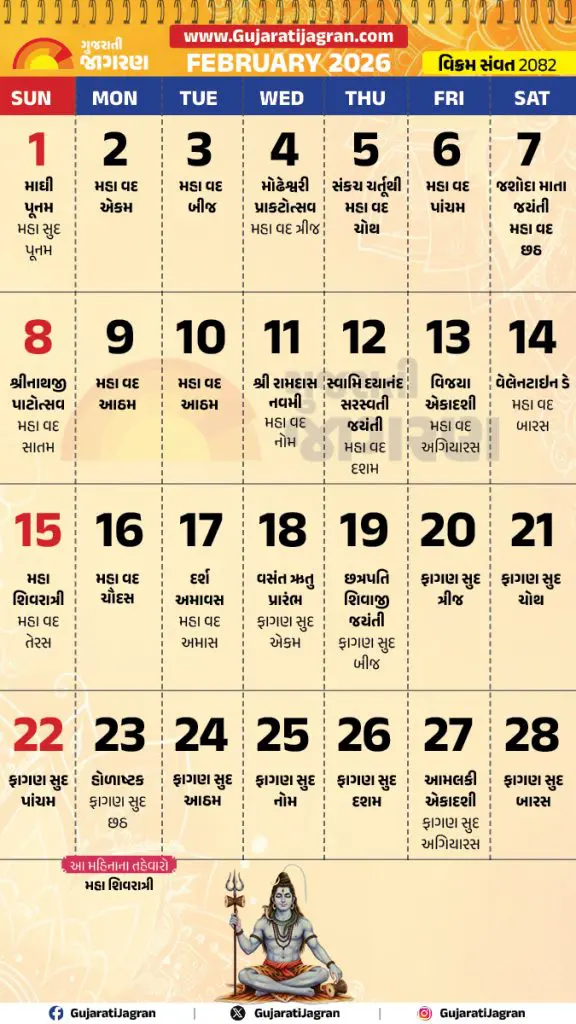
Here is a detailed breakdown of each day in February 2026, showing the corresponding Gujarati Tithi, Paksha, and any major observances or festivals. Remember that Tithi timings are based on Indian Standard Time (IST) and may require adjustment for your specific time zone in the USA. The Tithis listed are the primary Tithis active for the majority of that day.
| English Date | Day | Gujarati Month | Paksha | Tithi (તિથિ) | Key Observances / Festivals |
|---|---|---|---|---|---|
| February 1, 2026 | Sunday | Maha | Shukla | Punam (પૂનમ) | Maha Sud Punam, Magha Purnima, Guru Ravidas Jayanti |
| February 2, 2026 | Monday | Maha | Krishna | Vad Padvo (વદ પડવો) | Beginning of Krishna Paksha |
| February 3, 2026 | Tuesday | Maha | Krishna | Vad Bij (વદ બીજ) | |
| February 4, 2026 | Wednesday | Maha | Krishna | Vad Trij (વદ ત્રીજ) | |
| February 5, 2026 | Thursday | Maha | Krishna | Vad Choth (વદ ચોથ) | Sankashti Chaturthi (if moonrise criteria met) |
| February 6, 2026 | Friday | Maha | Krishna | Vad Pancham (વદ પાંચમ) | |
| February 7, 2026 | Saturday | Maha | Krishna | Vad Chhath (વદ છઠ) | |
| February 8, 2026 | Sunday | Maha | Krishna | Vad Saptam (વદ સાતમ) | |
| February 9, 2026 | Monday | Maha | Krishna | Vad Atham (વદ આઠમ) | Kalashtami |
| February 10, 2026 | Tuesday | Maha | Krishna | Vad Nom (વદ નોમ) | |
| February 11, 2026 | Wednesday | Maha | Krishna | Vad Dasham (વદ દશમ) | |
| February 12, 2026 | Thursday | Maha | Krishna | Vad Agiyaras (વદ અગિયારસ) | |
| February 13, 2026 | Friday | Maha | Krishna | Vad Baras (વદ બારસ) | Vijaya Ekadashi (વદ અગિયારસ is on Feb 12, but some observances span. Vijaya Ekadashi often crosses into the next day depending on Tithi end time and sunrise for Parana) |
| February 14, 2026 | Saturday | Maha | Krishna | Vad Teras (વદ તેરસ) | Pradosh Vrat |
| February 15, 2026 | Sunday | Maha | Krishna | Vad Chaudas (વદ ચૌદસ) | Maha Shivratri |
| February 16, 2026 | Monday | Maha | Krishna | Vad Amas (વદ અમાસ) | Maha Shivratri (Nishita Kaal), Shani Amavasya (if applicable) |
| February 17, 2026 | Tuesday | Maha | Krishna | Amavasya (અમાવસ્યા) | Maha Vad Amavasya, Bhauvati Amavasya (if Tuesday) |
| February 18, 2026 | Wednesday | Fagan | Shukla | Sud Padvo (સુદ પડવો) | Beginning of Fagan month, Phulera Dooj (some regions) |
| February 19, 2026 | Thursday | Fagan | Shukla | Sud Bij (સુદ બીજ) | Ramadan Fasting Starts (for Islamic calendar) |
| February 20, 2026 | Friday | Fagan | Shukla | Sud Trij (સુદ ત્રીજ) | |
| February 21, 2026 | Saturday | Fagan | Shukla | Sud Choth (સુદ ચોથ) | Vinayaka Chaturthi |
| February 22, 2026 | Sunday | Fagan | Shukla | Sud Pancham (સુદ પાંચમ) | Basant Panchami (often in Jan/Feb, check exact Tithi) |
| February 23, 2026 | Monday | Fagan | Shukla | Sud Chhath (સુદ છઠ) | |
| February 24, 2026 | Tuesday | Fagan | Shukla | Sud Saptam (સુદ સાતમ) | Ratha Saptami (if in Fagan) |
| February 25, 2026 | Wednesday | Fagan | Shukla | Sud Atham (સુદ આઠમ) | Holika Dahan preparations begin |
| February 26, 2026 | Thursday | Fagan | Shukla | Sud Nom (સુદ નોમ) | |
| February 27, 2026 | Friday | Fagan | Shukla | Sud Dasham (સુદ દશમ) | |
| February 28, 2026 | Saturday | Fagan | Shukla | Sud Agiyaras (સુદ અગિયારસ) | Amalaki Ekadashi |
Disclaimer: Tithi timings are based on general calculations for India (IST). For precise observance in your specific US location, it’s always recommended to consult a local Gujarati Panchang or an astrologer who can calculate timings based on your geographical coordinates. Dates for some festivals can shift by a day depending on the exact start/end times of Tithis relative to sunrise.
Key Festivals and Observances in February 2026 (Gujarati Calendar)
February 2026 is rich with spiritual significance. Here are some of the major observances and festivals during this month:
Maha Sud Punam (Magha Purnima) – February 1st
Maha Sud Punam, also known as Magha Purnima, marks the full moon day in the Gujarati month of Maha. This day is considered extremely sacred for religious bathing in holy rivers, charity (daan), and spiritual austerities. Devotees believe that performing good deeds on this day helps achieve salvation (moksha). It’s a powerful day for spiritual cleansing and meditation.
Vijaya Ekadashi (Maha Vad Agiyaras) – February 12th/13th
Vijaya Ekadashi falls on the 11th Tithi (Agiyaras) of the Krishna Paksha in the month of Maha. The word ‘Vijaya’ means ‘victory.’ Observing a fast on this Ekadashi is believed to grant victory in endeavors and overcome obstacles, particularly in spiritual battles against internal vices. Devotees fast from sunrise to sunrise, offering prayers to Lord Vishnu and seeking his blessings for success.
Maha Shivratri (Maha Vad Chaudas / Amas) – February 15th/16th
Maha Shivratri, one of the most significant festivals in Hinduism, is celebrated on the 14th Tithi (Chaudas) of the Krishna Paksha in the month of Maha. This is the ‘Great Night of Shiva,’ commemorating the convergence of Shiva and Parvati, and the day Shiva performed the ‘Tandava’ dance. Devotees observe a strict fast, perform Lingam Puja, chant mantras, and stay awake all night in prayer (jagarana) to seek Lord Shiva’s blessings for spiritual growth, prosperity, and liberation.
Maha Vad Amavasya – February 17th
Amavasya, the New Moon day, holds considerable religious importance. The Amavasya in the month of Maha is particularly sacred for performing rituals for ancestors (Tarpan and Shraddh). It’s a day to honor departed souls, offer prayers, and perform charitable acts to ensure peace and well-being for one’s forefathers. On certain weekdays, like Tuesday, it can be called Bhaumvati Amavasya, further enhancing its significance.
Amalaki Ekadashi (Fagan Sud Agiyaras) – February 28th
Falling in the Shukla Paksha of Fagan, Amalaki Ekadashi is dedicated to the Amla tree (Indian gooseberry), which is considered sacred to Lord Vishnu. Devotees worship the Amla tree and Lord Vishnu on this day, believing that it brings immense merit, health, and liberation. Fasting on this day is also a common practice to please the deity.
How to Use the Gujarati Calendar in the USA: Tips for Precision
Living in the USA while adhering to a calendar based on Indian timings can be tricky. Here’s how to navigate it:
Time Zone Adjustments: Converting IST to EST/CST/PST
Most traditional Panchangs (including the Tithi timings listed here) are calculated for India Standard Time (IST). The USA spans multiple time zones (Eastern, Central, Mountain, Pacific, Alaska, Hawaii). You need to account for this difference:
- IST to Eastern Standard Time (EST): IST is 9.5 hours ahead of EST. If a Tithi ends at 10:00 AM IST, it ends at 12:30 AM EST on the same day.
- IST to Central Standard Time (CST): IST is 10.5 hours ahead of CST.
- IST to Mountain Standard Time (MST): IST is 11.5 hours ahead of MST.
- IST to Pacific Standard Time (PST): IST is 12.5 hours ahead of PST.
Example: If a Tithi begins at 6:00 AM IST on February 1st, it would begin at 7:30 PM PST on January 31st. This means a Tithi might span two Gregorian days in the US, or a new Tithi might begin in the evening of the previous Gregorian day.
Local Sunrise/Sunset: Why it Matters for Observances
Many Hindu observances, particularly fasts (Vrats) and festival rituals, are determined by the sunrise (Surya Uday) and sunset (Surya Ast) in your specific location. For instance, an Ekadashi fast is usually broken after sunrise on Dwadashi (the 12th Tithi), and the Tithi active at sunrise is often considered the ‘main’ Tithi for that Gregorian day.
Therefore, while the Tithi table gives you a general idea, for strict adherence, you need to check a local Panchang or app that provides timings based on your exact US city. This accounts for variations in day length and astronomical calculations specific to your longitude and latitude.
Digital Tools and Resources
Thankfully, technology makes it easier. Many reputable online platforms and mobile apps provide Hindu calendars and Panchang data that can be customized for your exact location in the USA. These tools often automatically adjust for time zones and sunrise/sunset, offering precise timings for Tithis, Muhurats, and festivals.
Beyond February: Looking Ahead in the Gujarati Calendar 2026
While this guide focuses on February, the Gujarati calendar continues its intricate cycle throughout 2026 (Vikram Samvat 2082). After Fagan, you’ll move into the months of Chaitra, Vaishakh, and so on, each bringing its own unique set of festivals like Chaitra Navratri, Ram Navami, and Akshaya Tritiya. Staying connected to the calendar allows you to anticipate these important dates and continue your cultural and spiritual journey year-round.
Why Understanding Tithis Matters
Understanding Tithis is not just about marking dates; it’s about connecting with a deeper rhythm of life. Each Tithi carries a unique energy and significance in Vedic astrology and Hindu traditions. Knowing the active Tithi can guide you in:

- Planning Auspicious Events: From starting new ventures to performing specific ceremonies (like a housewarming or wedding), certain Tithis are considered more favorable (Shubh Muhurat) than others.
- Observing Fasts and Vrats: Many fasts are Tithi-specific (e.g., Ekadashi, Chaturthi Vrat). Adhering to the correct Tithi is crucial for the spiritual benefits.
- Spiritual Practices: Some Tithis are ideal for meditation, mantra chanting, or specific devotional acts.
- Cultural Connection: For Gujaratis living abroad, following the traditional calendar is a powerful way to stay connected to their heritage and pass it on to future generations.
We hope this detailed guide to the Gujarati Calendar 2026 for February, with its focus on Tithis and practical application for a US audience, empowers you to embrace your traditions with clarity and confidence. Jai Shri Krishna!
Frequently Asked Questions
What is the Gujarati Calendar 2026 (Vikram Samvat 2082) in February?
The Gujarati Calendar for February 2026 primarily covers the latter part of the Gujarati month of Maha and the beginning of Fagan. It’s based on the Vikram Samvat 2082, a lunisolar calendar crucial for determining Hindu festivals, Tithis (lunar days), and auspicious timings. February 1st is Maha Sud Punam, and February 17th is Maha Vad Amavasya, with Fagan Sud Padvo starting on February 18th.
What are the major festivals in the Gujarati Calendar for February 2026?
Key festivals and observances in February 2026 include Maha Sud Punam (Magha Purnima) on February 1st, Vijaya Ekadashi (Maha Vad Agiyaras) on February 12th/13th, Maha Shivratri (Maha Vad Chaudas / Amas) on February 15th/16th, and Maha Vad Amavasya on February 17th. Amalaki Ekadashi (Fagan Sud Agiyaras) falls on February 28th.
How do I adjust Gujarati Tithi timings for my time zone in the USA?
Gujarati Tithi timings are typically given in Indian Standard Time (IST). To convert to US time zones, subtract 9.5 hours for EST, 10.5 hours for CST, 11.5 hours for MST, and 12.5 hours for PST. For instance, if a Tithi ends at 10:00 AM IST, it would be 9:30 PM PST the previous day. For precise local timings, it’s best to use a local Panchang app or website that adjusts for your specific city and sunrise/sunset.
What is a ‘Tithi’ and why is it important in the Gujarati calendar?
A Tithi is a lunar day, defined by a 12-degree difference in the longitudinal angle between the sun and the moon. There are 15 Tithis in each lunar fortnight (Paksha). Tithis are crucial because they dictate the exact timing for all Hindu festivals, fasts (Vrats), and auspicious periods (Muhurats). Their variable length means they don’t always align with a single Gregorian day.
What do ‘Shukla Paksha’ and ‘Krishna Paksha’ mean?
‘Paksha’ refers to the two lunar fortnights that make up a lunar month. ‘Shukla Paksha’ is the waxing fortnight, from the New Moon (Amavasya) to the Full Moon (Purnima), when the moon’s visible portion increases. ‘Krishna Paksha’ is the waning fortnight, from the Full Moon to the New Moon, when the moon’s visible portion decreases.
Where can I find an accurate Gujarati calendar for my US location?
While general calendars provide IST timings, for accuracy in the US, consult digital Panchang applications or websites that allow you to select your specific city and time zone. These tools factor in local sunrise/sunset and geographical coordinates for precise Tithi and Muhurat calculations, which are vital for religious observances.