Gujarati Calendar February 2026: Your Definitive Guide to Tithi, Festivals & Auspicious Timings
Ever found yourself juggling between the Gregorian calendar and the intricate rhythms of the Gujarati Panchang, especially when trying to pinpoint a specific Tithi or a significant festival in the USA? It’s a common experience for many of us who cherish our cultural roots while living in a different time zone. February 2026 is no exception, bringing with it the tail end of Maha month and the beginning of Fagan, marked by the powerful observance of Maha Shivaratri.
Table of Contents
- Gujarati Calendar February 2026: Your Definitive Guide to Tithi, Festivals & Auspicious Timings
- Navigating February 2026 with the Gujarati Calendar
- February 2026 Gujarati Calendar & Tithi Overview (The Quick Reference)
- Decoding the Gujarati Calendar: Beyond Just Dates
- What is the Gujarati Calendar (Vikram Samvat)?
- Understanding Tithi: The Heartbeat of the Lunar Day
- Key Festivals and Events in February 2026
- Auspicious Timings & Muhurats in February 2026
- General Auspicious Tithis for February 2026
- Planning Key Events: Marriage, Griha Pravesh & New Ventures
- Practical Tips for Using Your Gujarati Calendar in the USA
- Time Zone Adjustments & Local Panchang
- Integrating Traditional & Modern Calendars
You’re not just looking for a list of dates; you’re seeking clarity, understanding, and the practical application of these ancient calculations. You want to know when to observe a fast, when to begin something new, or simply how to connect with the spiritual pulse of the Gujarati calendar. That’s precisely what we’re here to unravel. Forget fragmented information; this guide is designed to be your one-stop resource for February 2026, offering detailed Tithi information, festival insights, and an understanding of why these dates hold such profound meaning.
Navigating February 2026 with the Gujarati Calendar
February 2026 aligns with a significant period in the Gujarati Vikram Samvat 2082. It begins in the second half (Krishna Paksha) of the Maha month, leading to Maha Vad Amas (new moon) around mid-February, which marks the transition into the new lunar month of Fagan (Phalguna). This particular month is charged with spiritual energy, especially due to Maha Shivaratri, making precise Tithi knowledge invaluable for observance.
February 2026 Gujarati Calendar & Tithi Overview (The Quick Reference)
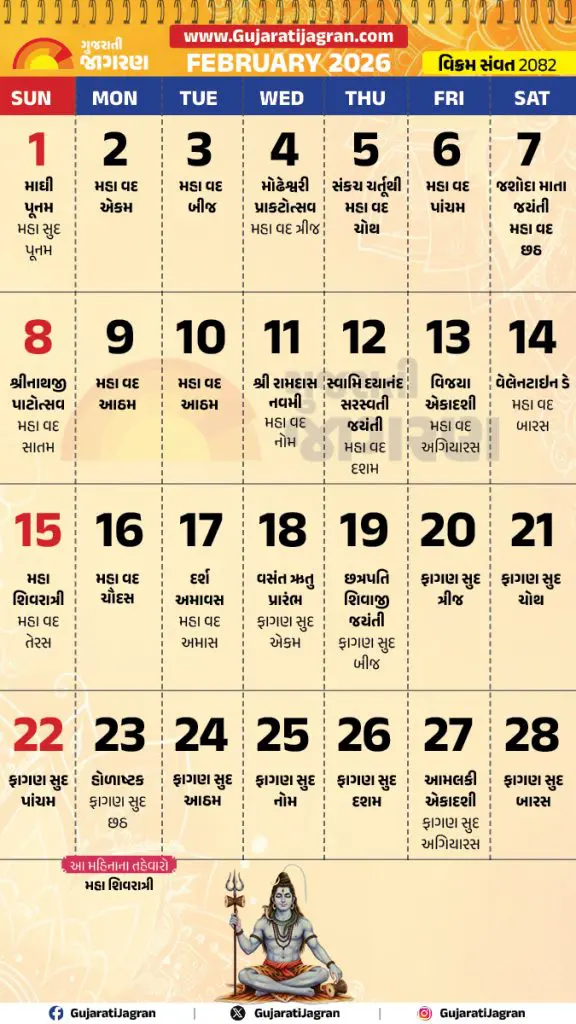
Here’s your comprehensive daily breakdown for February 2026, integrating Gregorian dates with their corresponding Gujarati Tithis, Paksha (fortnight), and important notes. This table is meticulously compiled to give you all the critical information at a glance, making it easy to plan your observances and activities.

| Gregorian Date | Day | Gujarati Month (Vikram Samvat 2082) | Paksha | Tithi Name (Gujarati) | Tithi Number | Important Notes / Festivals |
|---|---|---|---|---|---|---|
| Feb 1, 2026 | Sunday | Maha | Shukla (Sud) | Punam / Purnima | 15 | Maha Sud Punam (Full Moon) |
| Feb 2, 2026 | Monday | Maha | Krishna (Vad) | Padvo / Pratipada | 1 | Start of Krishna Paksha |
| Feb 3, 2026 | Tuesday | Maha | Krishna (Vad) | Bij / Dwitiya | 2 | |
| Feb 4, 2026 | Wednesday | Maha | Krishna (Vad) | Trij / Tritiya | 3 | |
| Feb 5, 2026 | Thursday | Maha | Krishna (Vad) | Choth / Chaturthi | 4 | |
| Feb 6, 2026 | Friday | Maha | Krishna (Vad) | Pancham / Panchami | 5 | |
| Feb 7, 2026 | Saturday | Maha | Krishna (Vad) | Chhath / Shashthi | 6 | |
| Feb 8, 2026 | Sunday | Maha | Krishna (Vad) | Satam / Saptami | 7 | |
| Feb 9, 2026 | Monday | Maha | Krishna (Vad) | Atham / Ashtami | 8 | |
| Feb 10, 2026 | Tuesday | Maha | Krishna (Vad) | Nom / Navami | 9 | |
| Feb 11, 2026 | Wednesday | Maha | Krishna (Vad) | Dasham / Dashami | 10 | |
| Feb 12, 2026 | Thursday | Maha | Krishna (Vad) | Ekadashi / Agyaras | 11 | Shattila Ekadashi Vrat |
| Feb 13, 2026 | Friday | Maha | Krishna (Vad) | Baras / Dwadashi | 12 | |
| Feb 14, 2026 | Saturday | Maha | Krishna (Vad) | Teras / Trayodashi | 13 | |
| Feb 15, 2026 | Sunday | Maha | Krishna (Vad) | Chaudas / Chaturdashi | 14 | Maha Shivaratri |
| Feb 16, 2026 | Monday | Maha | Krishna (Vad) | Amas / Amavasya | 15 | Maha Vad Amas (New Moon) |
| Feb 17, 2026 | Tuesday | Fagan | Shukla (Sud) | Padvo / Pratipada | 1 | Start of Fagan Month & Shukla Paksha |
| Feb 18, 2026 | Wednesday | Fagan | Shukla (Sud) | Bij / Dwitiya | 2 | |
| Feb 19, 2026 | Thursday | Fagan | Shukla (Sud) | Trij / Tritiya | 3 | |
| Feb 20, 2026 | Friday | Fagan | Shukla (Sud) | Choth / Chaturthi | 4 | |
| Feb 21, 2026 | Saturday | Fagan | Shukla (Sud) | Pancham / Panchami | 5 | |
| Feb 22, 2026 | Sunday | Fagan | Shukla (Sud) | Chhath / Shashthi | 6 | |
| Feb 23, 2026 | Monday | Fagan | Shukla (Sud) | Satam / Saptami | 7 | |
| Feb 24, 2026 | Tuesday | Fagan | Shukla (Sud) | Atham / Ashtami | 8 | |
| Feb 25, 2026 | Wednesday | Fagan | Shukla (Sud) | Nom / Navami | 9 | |
| Feb 26, 2026 | Thursday | Fagan | Shukla (Sud) | Dasham / Dashami | 10 | |
| Feb 27, 2026 | Friday | Fagan | Shukla (Sud) | Ekadashi / Agyaras | 11 | Amalaki Ekadashi Vrat |
| Feb 28, 2026 | Saturday | Fagan | Shukla (Sud) | Baras / Dwadashi | 12 |
Decoding the Gujarati Calendar: Beyond Just Dates
The Gujarati Calendar isn’t just a system for marking days; it’s a living tradition, deeply interwoven with cultural practices, festivals, and personal auspicious timings. Understanding its nuances empowers you to engage more fully with your heritage.
What is the Gujarati Calendar (Vikram Samvat)?
The Gujarati Calendar is a lunisolar calendar, meaning it’s based on both the moon’s phases and the sun’s annual cycle. Predominantly followed in Gujarat, it’s a regional variant of the Vikram Samvat, a historical Hindu calendar widely used in the Indian subcontinent. It differs from other Hindu calendars (like the North Indian Purnimant or Shalivahana Shaka Samvat) primarily in its New Year’s Day, which typically falls on the day after Diwali (Kartak Sud Padvo).
In the Gujarati tradition, the year 2026 corresponds to Vikram Samvat 2082. The calendar plays a pivotal role in determining festival dates, auspicious timings (Muhurats), and the scheduling of various religious and social ceremonies. Its intricate calculations ensure that the agricultural, social, and spiritual cycles remain in harmony.
Understanding Tithi: The Heartbeat of the Lunar Day
At the core of any Hindu lunisolar calendar, including the Gujarati one, is the concept of Tithi. A Tithi isn’t a fixed 24-hour day like in the Gregorian calendar. Instead, it’s a specific lunar day, defined by the time it takes for the longitudinal angle between the sun and the moon to increase by 12 degrees. Because the moon’s movement isn’t perfectly uniform, a Tithi can be shorter or longer than a solar day, sometimes leading to two Tithis on a single Gregorian day, or a Tithi skipping a Gregorian day entirely.
There are 30 Tithis in a lunar month, divided into two fortnights or Pakshas:
- Shukla Paksha (Sud): The bright fortnight, when the moon waxes from New Moon (Amavasya) to Full Moon (Purnima). The Tithis are numbered 1 (Padvo/Pratipada) to 15 (Punam/Purnima).
- Krishna Paksha (Vad): The dark fortnight, when the moon wanes from Full Moon (Purnima) to New Moon (Amavasya). The Tithis are numbered 1 (Padvo/Pratipada) to 15 (Amas/Amavasya).
Each Tithi carries its own unique energy and significance, dictating which activities are considered auspicious or inauspicious. For instance, specific Tithis are ideal for starting new ventures, performing religious rituals, or observing fasts (like Ekadashi).
Key Festivals and Events in February 2026
February 2026 holds particular spiritual importance, most notably for the observance of Maha Shivaratri. Let’s delve into the major events:
- Maha Sud Punam (Feb 1, 2026): The full moon day of Maha month. This day is often associated with spiritual activities, charity, and specific fasts depending on regional traditions.
- Shattila Ekadashi Vrat (Feb 12, 2026): This Ekadashi falls on Maha Vad Ekadashi. Observing this fast involves using six types of sesame seeds (til) for various rituals – bathing with sesame water, applying sesame paste, offering sesame as sacrifice, eating sesame, donating sesame, and giving water mixed with sesame. It’s believed to absolve sins and grant spiritual merit.
- Maha Shivaratri (Feb 15, 2026): Falling on Maha Vad Chaudas (the 14th Tithi of the Krishna Paksha in Maha month), this is one of the most significant festivals dedicated to Lord Shiva. Devotees observe a day-long fast, chant mantras, and perform puja to Shiva Lingam throughout the night. It’s believed that on this night, Lord Shiva performs the heavenly dance of creation, preservation, and destruction. Many abstain from food and water, engaging in deep meditation and prayer.
- Maha Vad Amas (Feb 16, 2026): The new moon day of Maha month. This day is traditionally observed for performing Shraddh (ancestral rites) and other auspicious activities for departed souls. It also marks the end of Maha month and the transition to Fagan.
- Amalaki Ekadashi Vrat (Feb 27, 2026): This Ekadashi falls on Fagan Sud Ekadashi. It is dedicated to Lord Vishnu and the Amla (Indian gooseberry) tree, considered sacred. Worshipping the Amla tree and observing a fast on this day is believed to bestow good health, prosperity, and liberation.
Auspicious Timings & Muhurats in February 2026
Understanding Muhurat, an auspicious time slot, is crucial in Gujarati culture for ensuring success and positive outcomes for important life events. While a full Panchang considers Nakshatra, Yoga, and Karana, Tithi is a fundamental component.
General Auspicious Tithis for February 2026
For general planning, certain Tithis are universally considered more favorable, while others are best avoided for significant undertakings:
- Generally Auspicious Tithis (Shukla Paksha): Padvo (Pratipada), Bij (Dwitiya), Trij (Tritiya), Pancham (Panchami), Satam (Saptami), Dasham (Dashami), Ekadashi (Agyaras), Baras (Dwadashi), Teras (Trayodashi). These are often suitable for starting new ventures, travel, or religious ceremonies.
- Generally Auspicious Tithis (Krishna Paksha): Bij (Dwitiya), Trij (Tritiya), Pancham (Panchami), Satam (Saptami), Dasham (Dashami), Dwadashi (Baras).
- Tithis to Approach with Caution (or Avoid for Major Events):
- Choth (Chaturthi): Often associated with obstacles.
- Nom (Navami): Can be inauspicious for new beginnings.
- Chaudas (Chaturdashi): Especially in Krishna Paksha, as seen with Maha Shivaratri, it’s a day of intense spiritual focus, not typically for worldly beginnings.
- Amas (Amavasya) & Punam (Purnima): While spiritually significant for specific rituals, they are generally avoided for starting new projects or major worldly commitments due to their transitional energies.
In February 2026, the Shukla Paksha of Fagan month (Feb 17-28) generally offers more favorable Tithis for new beginnings compared to the Krishna Paksha of Maha month, which is more suited for introspection, fasting, and spiritual purification.

Planning Key Events: Marriage, Griha Pravesh & New Ventures
When it comes to life’s biggest milestones – a wedding, moving into a new home (Griha Pravesh), or launching a new business – consulting a full Panchang and an experienced astrologer for a personalized Muhurat is always recommended. This is because a precise Muhurat considers not just the Tithi, but also the planetary positions (grahas), specific lunar mansions (nakshatras), and other astrological factors relevant to the individuals involved.
However, armed with your Tithi knowledge for February 2026, you can make informed initial assessments:
- For Marriage (Lagna Muhurat): Generally, Trij (Tritiya), Pancham (Panchami), Satam (Saptami), Dasham (Dashami), and Ekadashi (Agyaras) of the Shukla Paksha are considered favorable, provided other astrological factors align. Avoid Amas, Punam, Choth, Nom, and Chaudas.
- For Griha Pravesh (Housewarming): Similarly, auspicious Tithis in Shukla Paksha like Bij, Trij, Pancham, Satam, Dasham, and Dwadashi are often preferred. The latter half of February (Fagan Sud) would be more conducive.
- For New Ventures / Business Inauguration: Opt for Tithis that promote growth and stability, typically from the Shukla Paksha (Feb 17-28, excluding days like Choth, Nom). Avoid days like Amas and Punam, which carry different energies.
Remember, the goal is to align your actions with the cosmic energies for the best possible outcome. While this guide provides a general overview for February 2026, individual circumstances and specific astrological charts always provide the most accurate Muhurat.
Practical Tips for Using Your Gujarati Calendar in the USA
Living in the USA presents unique considerations for following the Gujarati calendar. Here’s how you can make it work seamlessly:
Time Zone Adjustments & Local Panchang
This is perhaps the most critical aspect for those of us outside India. Tithis are calculated based on the precise moments of lunar and solar alignments, which means they are highly sensitive to geographical location and time zones. A Tithi that begins at sunset in Ahmedabad might begin in the early morning in New York, or even carry over from the previous day, impacting which Gregorian date it falls on.
- Always Use a Local Panchang: Rely on online Gujarati calendars or apps that allow you to set your specific city or time zone in the USA. This ensures accurate Tithi timings for your location.
- Sunrise and Sunset are Key: For many rituals and fast observances (especially Ekadashi Parana – breaking the fast), the local sunrise and sunset times are paramount. These define the start and end of a Tithi for your specific area.
Integrating Traditional & Modern Calendars
You don’t have to choose between your traditional calendar and your daily planner. Here’s how to blend them:
- Cross-Reference: Use the detailed table provided here to mark down important Gujarati dates and Tithis directly into your digital or physical Gregorian calendar.
- Digital Tools: Many apps offer layered calendars where you can see both Gregorian and Gujarati dates simultaneously, often with notification features for festivals and Ekadashis.
- Plan Ahead: Knowing the upcoming Tithis and festivals for February 2026 in advance allows you to schedule work, travel, and social commitments around your cultural and spiritual observances without conflict.
By consciously integrating these two calendar systems, you ensure that you stay connected to your heritage while navigating the demands of modern life in the United States.
As we conclude this deep dive into the Gujarati Calendar for February 2026, I hope you feel more empowered and connected to the rich tapestry of Tithis, festivals, and auspicious timings. It’s more than just dates; it’s a profound system that links us to ancient wisdom and offers a roadmap for living a life in harmony with cosmic rhythms, wherever you are in the world. May your February 2026 be filled with meaningful observances and successful endeavors!
Frequently Asked Questions
What is the Gujarati Calendar, and how does it relate to February 2026?
The Gujarati Calendar is a lunisolar calendar, a variant of the Vikram Samvat, primarily followed in Gujarat, India. February 2026 falls within Vikram Samvat 2082 and covers the latter half of the Gujarati month of Maha and the beginning of Fagan. It uses lunar phases (Tithis) to determine significant dates and festivals.
What is a ‘Tithi’ and why is it important in the Gujarati Calendar?
A Tithi is a lunar day, defined by the time it takes for the moon’s angular distance from the sun to increase by 12 degrees. It’s crucial because Tithis determine the exact timing of festivals, fasts, and auspicious periods (Muhurats) for various activities. Unlike Gregorian days, Tithis can vary in length.

When is Maha Shivaratri in February 2026 according to the Gujarati Calendar?
Maha Shivaratri in February 2026 falls on Sunday, February 15, 2026. This corresponds to the Maha Vad Chaudas (14th Tithi of the Krishna Paksha of Maha month).
Are there any Ekadashi fasts in February 2026?
Yes, February 2026 features two Ekadashi fasts: Shattila Ekadashi Vrat on Thursday, February 12, 2026 (Maha Vad Ekadashi) and Amalaki Ekadashi Vrat on Friday, February 27, 2026 (Fagan Sud Ekadashi).
How do I use the Gujarati Calendar for planning events if I live in the USA?
It’s essential to use a Gujarati calendar or app that allows you to set your specific city or time zone in the USA. Tithis are calculated based on local sunrise/sunset, so this ensures accuracy. You can then cross-reference these dates with your Gregorian calendar for planning major life events, festivals, and fast observances.
What’s the difference between ‘Sud’ and ‘Vad’ in the Tithi names?
‘Sud’ (Shukla Paksha) refers to the ‘bright fortnight’ when the moon is waxing, moving from New Moon to Full Moon. ‘Vad’ (Krishna Paksha) refers to the ‘dark fortnight’ when the moon is waning, moving from Full Moon to New Moon. These indicate which half of the lunar month a Tithi belongs to.