Telugu Festivals in February 2026: Your Guide to Cultural Celebrations in the US Diaspora
Are you looking to connect with your Telugu heritage and plan your February 2026 around significant cultural and spiritual observances? Perhaps you’re in the US, navigating the beautiful blend of cultures, and want to ensure you don’t miss out on important festivals. You’ve come to the right place.
Table of Contents
- Telugu Festivals in February 2026: Your Guide to Cultural Celebrations in the US Diaspora
- February 2026 Telugu Festivals at a Glance: Dates & Key Observances
- Diving Deeper: Understanding Each February 2026 Telugu Festival
- Dwijapriya Sankashtahara Chaturthi (February 5, 2026)
- Vijaya Ekadashi (February 13, 2026)
- Shani Pradosh Vrat (February 14, 2026)
- Maha Shivaratri & Magha Amavasya (February 15, 2026)
- Maha Shivaratri
- Magha Amavasya
- Skanda Shashti (February 23, 2026)
- Durga Ashtami Vrat (February 24, 2026)
- The Broader Canvas: Significance of February in the Telugu Calendar
- Celebrating Telugu Festivals in the USA: Bridging Cultures
- Tips for Observing February 2026 Telugu Festivals
- Embracing the Spirit of Telugu Traditions
February 2026 is a spiritually rich month for the Telugu community, bridging the sacred month of Magha and ushering in Phalguna. It’s a period marked by deep devotion, specific fasting rituals, and celebrations dedicated to various deities. Whether you’re a devout follower, curious about your roots, or simply wish to understand the rhythm of the Telugu calendar, this guide provides all the essential details.
We’ll cut through the confusion of varying calendars and give you a definitive breakdown of the key Telugu festivals happening in February 2026, complete with their significance, observance details, and how you can participate, even from thousands of miles away in the United States. Let’s dive in!
February 2026 Telugu Festivals at a Glance: Dates & Key Observances
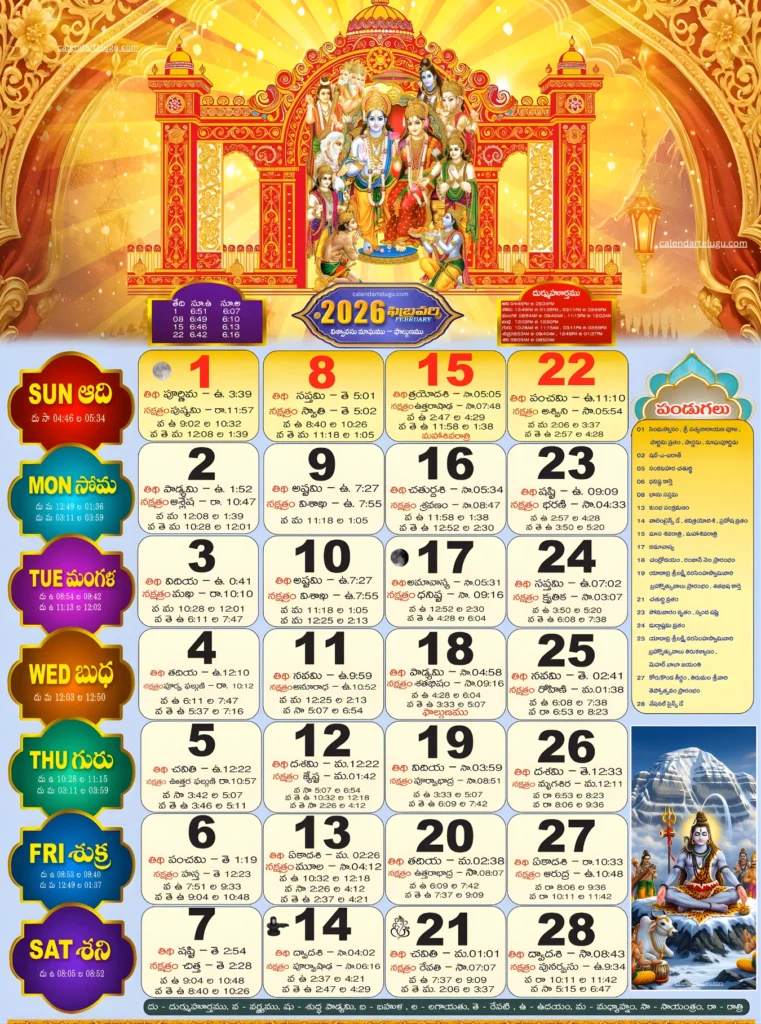
To help you quickly mark your calendar, here’s a summary of the major Telugu festivals and auspicious days falling in February 2026. This table provides a snapshot of the dates, the festival names, and their primary significance.
| Date (2026) | Day | Telugu Festival / Observance | Key Significance / Focus |
|---|---|---|---|
| February 5 | Thursday | Dwijapriya Sankashtahara Chaturthi | Dedicated to Lord Ganesha; fasting to overcome obstacles and receive blessings. |
| February 13 | Friday | Vijaya Ekadashi | Fasting day for Lord Vishnu; believed to grant victory and success in endeavors. |
| February 14 | Saturday | Shani Pradosh Vrat | Fasting and worship of Lord Shiva to mitigate the malefic effects of Shani (Saturn) and seek blessings. |
| February 15 | Sunday | Maha Shivaratri & Magha Amavasya | The Great Night of Shiva, celebrating the overcoming of darkness and ignorance. Coincides with the new moon (Amavasya), significant for ancestral rites. |
| February 23 | Monday | Skanda Shashti | Worship of Lord Kartikeya (Skanda or Muruga); prayers for valor, wisdom, and protection. |
| February 24 | Tuesday | Durga Ashtami Vrat | Fasting and worship of Goddess Durga; seeking protection from evil and divine blessings. |
Diving Deeper: Understanding Each February 2026 Telugu Festival
Now, let’s explore each of these significant days in more detail, understanding their roots, rituals, and how they resonate with the Telugu spiritual ethos.
Dwijapriya Sankashtahara Chaturthi (February 5, 2026)
Sankashtahara Chaturthi is a recurring monthly observance dedicated to Lord Ganesha, the remover of obstacles. The term “Sankashta” means deliverance from trouble, and “Hara” means to remove. On this day, devotees fast from sunrise until moonrise, praying to Lord Ganesha to overcome challenges and achieve success in their endeavors.

Significance: Lord Ganesha is revered as Vighnaharta, the one who removes obstacles, and Buddhi Pradaata, the giver of intellect. Observing this fast is believed to purify the mind, bring peace, and ensure that all undertakings are completed without hindrance. Dwijapriya is one of the 32 forms of Ganesha, and this specific Chaturthi is associated with his Dwijapriya aspect, making the day particularly potent for those seeking divine intervention in difficult situations.
Observances: Devotees typically wake early, take a purifying bath, and then observe a partial or full fast. They offer prayers to Ganesha, recite Ganesha mantras, and perform puja with flowers, incense, and a special offering of Modak (sweet dumplings) or Laddus. The fast is broken only after sighting the moon in the evening, followed by a final prayer to Ganesha.
Vijaya Ekadashi (February 13, 2026)
Ekadashi, the eleventh day of each lunar fortnight, is considered highly auspicious for devotees of Lord Vishnu. Among the 24 Ekadashis in a year, Vijaya Ekadashi holds special prominence. The word “Vijaya” translates to “victory,” and this Ekadashi is believed to bestow victory and success upon those who observe it with sincerity and devotion.
Significance: According to Hindu scriptures, observing Vijaya Ekadashi can lead to triumph over adversaries, success in legal battles, and overall prosperity. It is said that Lord Rama himself observed this Ekadashi before crossing the ocean to Lanka to rescue Sita, underscoring its power to grant success in daunting tasks. The fast helps in spiritual purification and cultivating inner strength.
Observances: The observance of Vijaya Ekadashi involves a strict fast, often abstaining from grains, legumes, and certain spices for 24 hours. Devotees spend the day chanting Vishnu mantras (like Om Namo Narayanaya or Hare Rama Hare Krishna), reading sacred texts such as the Bhagavad Gita or Vishnu Sahasranamam, and meditating. Breaking the fast is done on Dwadashi (the twelfth day) morning with specific foods, typically fruits and dairy products, followed by a sattvic (pure) meal.
Shani Pradosh Vrat (February 14, 2026)
Pradosh Vrat is observed on the 13th day of each lunar fortnight, dedicated to Lord Shiva and Goddess Parvati. When Pradosh Vrat falls on a Saturday, it is known as Shani Pradosh Vrat, carrying enhanced significance, especially for those seeking to mitigate the adverse effects of the planet Saturn (Shani).
Significance: Saturn (Shani Dev) is a powerful planetary deity in Vedic astrology, known for dispensing justice based on one’s karma. While often associated with challenges and difficulties, Shani also brings discipline and spiritual growth. Observing Shani Pradosh Vrat is believed to please Lord Shiva, who in turn can appease Shani Dev, reducing malefic influences and bestowing blessings of good health, wealth, and longevity. It is also observed by couples desiring progeny.
Observances: Devotees wake up early, bathe, and perform a Shiva puja. A strict fast is observed from sunrise until the Pradosh Kala (the twilight period just before and after sunset). During this time, special prayers, abhishekam (ritual bathing) of the Shiva Lingam, and chanting of Maha Mrityunjaya Mantra or Om Namah Shivaya are performed. The fast is typically broken after the evening puja with a simple, sattvic meal.
Maha Shivaratri & Magha Amavasya (February 15, 2026)
February 15, 2026, marks one of the most significant and widely celebrated Hindu festivals: Maha Shivaratri. This sacred night is dedicated to Lord Shiva, representing the overcoming of darkness and ignorance in life and the world. It is also believed to be the night when Shiva performed the Tandava, the cosmic dance of creation, preservation, and destruction, and the day Shiva and Parvati were married.
Coinciding with Maha Shivaratri on February 15, 2026, is Magha Amavasya, the new moon day of the Magha month. Amavasya holds profound significance for ancestral rites (Tarpanam) and other spiritual practices aimed at seeking blessings for departed souls and ensuring family well-being. The dual significance of this day amplifies its spiritual potency.
Maha Shivaratri
Significance: Maha Shivaratri is not a celebration of Shiva’s birthday but rather a night of intense spiritual introspection, self-realization, and devotion. It signifies the convergence of Shiva and Shakti, the masculine and feminine energies that sustain the universe. Many believe that on this night, the planetary positions are such that they aid in spiritual upliftment, making fasting and meditation particularly effective.
Observances: The core observances include a full day of fasting, remaining awake throughout the night (Jagaran), and performing Lingam Puja. Devotees ritually bathe the Shiva Lingam with water, milk, yogurt, honey, ghee, sugar, and Bilva leaves, believed to be very dear to Lord Shiva. Chanting the Maha Mrityunjaya Mantra and ‘Om Namah Shivaya’ continuously is a central practice. Temples organize special pujas, bhajans, and discourses throughout the night. Breaking the fast occurs the following morning after a final puja.
Magha Amavasya
Significance: Magha Amavasya is considered highly auspicious for performing Pinda Daan, Tarpanam, and Shraddha ceremonies for ancestors. It is believed that on this day, ancestors visit the earth plane, and offering prayers and food to them can bring peace to their souls and blessings to the family. Taking a holy dip in sacred rivers (like the Ganga) on this day is also considered highly meritorious.
Observances: Besides the Maha Shivaratri rituals, devotees may perform specific ancestral rites at home or at a temple. This often involves offering water, sesame seeds, and specific foods to ancestors. Charity and feeding the needy are also considered beneficial on Amavasya.
Skanda Shashti (February 23, 2026)
Skanda Shashti, also known as Subramanya Shashti, is observed on the sixth day (Shashti) of the lunar fortnight, primarily to honor Lord Kartikeya, also known as Skanda, Murugan, or Subramanya. He is the son of Lord Shiva and Goddess Parvati, and the commander of the celestial armies.
Significance: Lord Kartikeya is revered as the deity of war, victory, wisdom, and protection. Skanda Shashti commemorates his triumph over the demon Surapadman, symbolizing the victory of good over evil. Devotees observe this day to seek his blessings for valor, courage, removal of obstacles, good health, and progeny, particularly for children’s well-being.
Observances: Devotees typically observe a fast, often a partial fast (consuming only fruits and milk) or a full fast. Special pujas are performed for Lord Kartikeya, involving offerings of flowers, fruits, milk, and sweets. Chanting the Skanda Purana or Murugan Stuti is common. Many visit temples dedicated to Lord Murugan to offer their prayers and participate in community rituals.
Durga Ashtami Vrat (February 24, 2026)
Durga Ashtami Vrat is observed on the eighth day (Ashtami) of the lunar fortnight, dedicated to Goddess Durga, a powerful manifestation of Shakti, the divine feminine energy. This observance falls in the Shukla Paksha (waxing phase) of the lunar cycle.
Significance: Goddess Durga is revered as the mother of the universe, embodying strength, protection, and motherhood. Observing Durga Ashtami Vrat is believed to invoke her blessings for courage, protection from negative forces, prosperity, and the fulfillment of desires. It strengthens one’s resolve and connects them to the divine feminine power.
Observances: Devotees typically observe a day-long fast, abstaining from grains and non-vegetarian food. Elaborate pujas are performed for Goddess Durga, often involving offerings of red flowers, kumkum, bangles, and a special bhog (sacred food offering). Chanting Durga mantras, especially the Durga Saptashati, is a key practice. Many visit Durga temples to participate in special aratis and seek the Goddess’s blessings.
The Broader Canvas: Significance of February in the Telugu Calendar
Beyond the individual festivals, it’s worth understanding the cosmic backdrop of February 2026 within the Telugu calendar. This month largely falls within the Telugu month of Magha Masam, with the latter part ushering in Phalguna Masam. Each of these months carries its own spiritual weight and cultural nuances.
- Magha Masam: This is one of the holiest months in the Hindu calendar. It is traditionally associated with austerity (tapasya), charity (daan), and ritual bathing (snanam) in sacred rivers. Many spiritual aspirants intensify their practices during Magha. The festivals like Sankashtahara Chaturthi, Vijaya Ekadashi, Shani Pradosh, and especially Maha Shivaratri (which often marks the end of Magha or beginning of Phalguna in some traditions) underscore the month’s emphasis on spiritual purification, devotion, and seeking divine blessings. It’s a time to cleanse karma and draw closer to the divine.
- Phalguna Masam: Starting around mid-February, Phalguna brings with it a celebratory mood, although its major festivals like Holi fall in March 2026. This month signifies the transition from the austerity of winter to the vibrancy of spring. While February only sees the beginning of Phalguna, the underlying energy begins to shift towards joy, renewal, and community celebrations. The observances like Skanda Shashti and Durga Ashtami continue the theme of invoking divine power for protection and well-being as the seasons change.
In essence, February 2026 is a period of intense devotion, spiritual discipline, and the honoring of various aspects of the divine, from the wisdom of Ganesha and the protection of Vishnu, to the transformative power of Shiva and the strength of Durga and Kartikeya. It’s a month that encourages introspection, gratitude, and a deepening of one’s spiritual connection.
Celebrating Telugu Festivals in the USA: Bridging Cultures
For many Telugus living in the United States, observing these festivals is a powerful way to stay connected to their cultural and spiritual roots. It’s an act of identity, continuity, and community building, even thousands of miles away from Andhra Pradesh or Telangana.
The Challenges and Joys: Celebrating in the US comes with its own set of challenges—different time zones for auspicious timings, limited access to specific puja items, and often, the need to balance work/school schedules with religious observances. However, it also brings immense joy. These festivals become occasions to gather, share traditions, and educate younger generations about their heritage. The act of recreating traditions in a new land strengthens community bonds and fosters a unique cultural identity.
Role of Temples and Community Organizations: Telugu associations and Hindu temples across the US play a crucial role. They often organize collective pujas, cultural programs, and community meals on major festival days like Maha Shivaratri, providing a space for shared worship and celebration. These centers become beacons for cultural preservation, offering a touch of home and helping second and third-generation Telugu Americans experience the richness of their heritage.
Passing Traditions to Next Generations: For parents, these festivals are invaluable opportunities to transmit cultural knowledge and spiritual values to their children. Explaining the stories behind the festivals, involving kids in preparations, and participating in temple events helps cultivate an understanding and appreciation for Telugu traditions that might otherwise fade in a multicultural environment.
Modern Adaptations: While the essence of the festivals remains unchanged, their observance in the US often sees practical adaptations. For instance, while a full night vigil for Maha Shivaratri might be challenging, many participate in evening pujas and specific prayer sessions. Similarly, sourcing traditional ingredients might require a trip to an Indian grocery store or a creative substitute. These adaptations reflect the resilience and adaptability of traditions in a globalized world.
Tips for Observing February 2026 Telugu Festivals
Here are some practical tips to help you observe these Telugu festivals in the US, ensuring a meaningful and authentic experience:

- Consult a Local Panchang: While we’ve provided general dates, remember that specific timings for pujas, moon sightings, and fast-breaking can vary slightly based on your geographical location (e.g., East Coast vs. West Coast). Many online Telugu Panchang calendars allow you to input your city in the USA for precise local timings.
- Connect with Your Community: Reach out to local Telugu associations, Hindu temples, or spiritual centers in your city or state. They often publish calendars of events and provide opportunities for communal celebrations, which can significantly enhance your festival experience.
- Prepare in Advance: For fasting days, plan your meals (if observing a partial fast) and ensure you have puja items like flowers, incense, specific leaves (like Bilva for Shiva), and offerings ready. Indian grocery stores are excellent resources for many traditional items.
- Simple Home Observances: Even if you can’t visit a temple or have access to all traditional items, a simple puja at home with devotion is highly effective. Light a lamp, offer water and flowers, chant mantras, and reflect on the festival’s significance.
- Involve the Family: Make festival preparations and observances a family activity. Explain the stories and significance to children, involving them in simple tasks. This creates lasting memories and fosters a sense of cultural belonging.
- Embrace the Spirit: Beyond the rituals, remember the spiritual essence of each festival. Whether it’s the removal of obstacles (Ganesha), the quest for victory (Vishnu), or the triumph over ignorance (Shiva), focus on the inner meaning and how it applies to your life.
Embracing the Spirit of Telugu Traditions
February 2026 offers a beautiful tapestry of Telugu festivals, each weaving threads of devotion, cultural heritage, and spiritual growth. From the solemn fasting of Ekadashi and Chaturthi to the profound night of Maha Shivaratri, these observances provide opportunities for introspection, community connection, and a reinforcement of faith.
For Telugus in the US, these festivals are more than just dates on a calendar; they are living traditions that bridge continents and generations. By understanding their significance and participating with an open heart, you not only honor your heritage but also enrich your personal spiritual journey. May your February 2026 be filled with peace, devotion, and the blessings of these sacred days.
Frequently Asked Questions
What are the major Telugu festivals in February 2026?
February 2026 is rich with several significant Telugu festivals and observances. Key dates include Dwijapriya Sankashtahara Chaturthi (Feb 5), Vijaya Ekadashi (Feb 13), Shani Pradosh Vrat (Feb 14), Maha Shivaratri and Magha Amavasya (Feb 15), Skanda Shashti (Feb 23), and Durga Ashtami Vrat (Feb 24).
What is the significance of Maha Shivaratri in February 2026?
Maha Shivaratri on February 15, 2026, is one of the most important festivals dedicated to Lord Shiva. It symbolizes the overcoming of darkness and ignorance. Devotees observe a day-long fast, perform ‘Jagaran’ (night vigil), and offer prayers and ‘Abhishekam’ to the Shiva Lingam, chanting mantras like ‘Om Namah Shivaya’.
How are Telugu festivals observed by people living in the USA?
Telugus in the USA celebrate by observing fasts, performing pujas at home, and visiting local Hindu temples or Telugu community centers. These organizations often arrange collective pujas and cultural events, helping to preserve traditions and pass them on to younger generations despite geographical distance.
Why are there different types of Chaturthi or Ekadashi mentioned?
Each month has two Chaturthis (fourth day) and two Ekadashis (eleventh day) in the lunar calendar. Specific names like ‘Dwijapriya Sankashtahara Chaturthi’ or ‘Vijaya Ekadashi’ are assigned based on the particular lunar month they fall in and their unique mythological or spiritual significance, often linked to specific deities or virtues.
What is Shani Pradosh Vrat, and why is it important?
Shani Pradosh Vrat occurs when the Pradosh Vrat (13th day of the lunar fortnight, dedicated to Lord Shiva) falls on a Saturday (Shaniwar). Observed on February 14, 2026, its significance is amplified for devotees seeking to mitigate the malefic effects of the planet Saturn (Shani Dev) and gain the blessings of Lord Shiva for protection, health, and prosperity.
Do I need a specific Telugu Panchang for observing these festivals in the US?
Yes, it is highly recommended to consult a local Telugu Panchang or an online calendar that allows you to set your specific US city and state. Auspicious timings for rituals like moonrise for Chaturthi, or the precise beginning and end of ‘Pradosh Kala,’ can vary significantly based on your geographical location and time zone.
What is Magha Amavasya, and what are its observances?
Magha Amavasya, falling on February 15, 2026, is the new moon day of the Magha month. It is considered highly auspicious for performing ancestral rites such as Pinda Daan, Tarpanam, and Shraddha ceremonies. Devotees often make offerings to ancestors, perform charity, and may take a holy dip in sacred waters to seek blessings for departed souls and family well-being.